
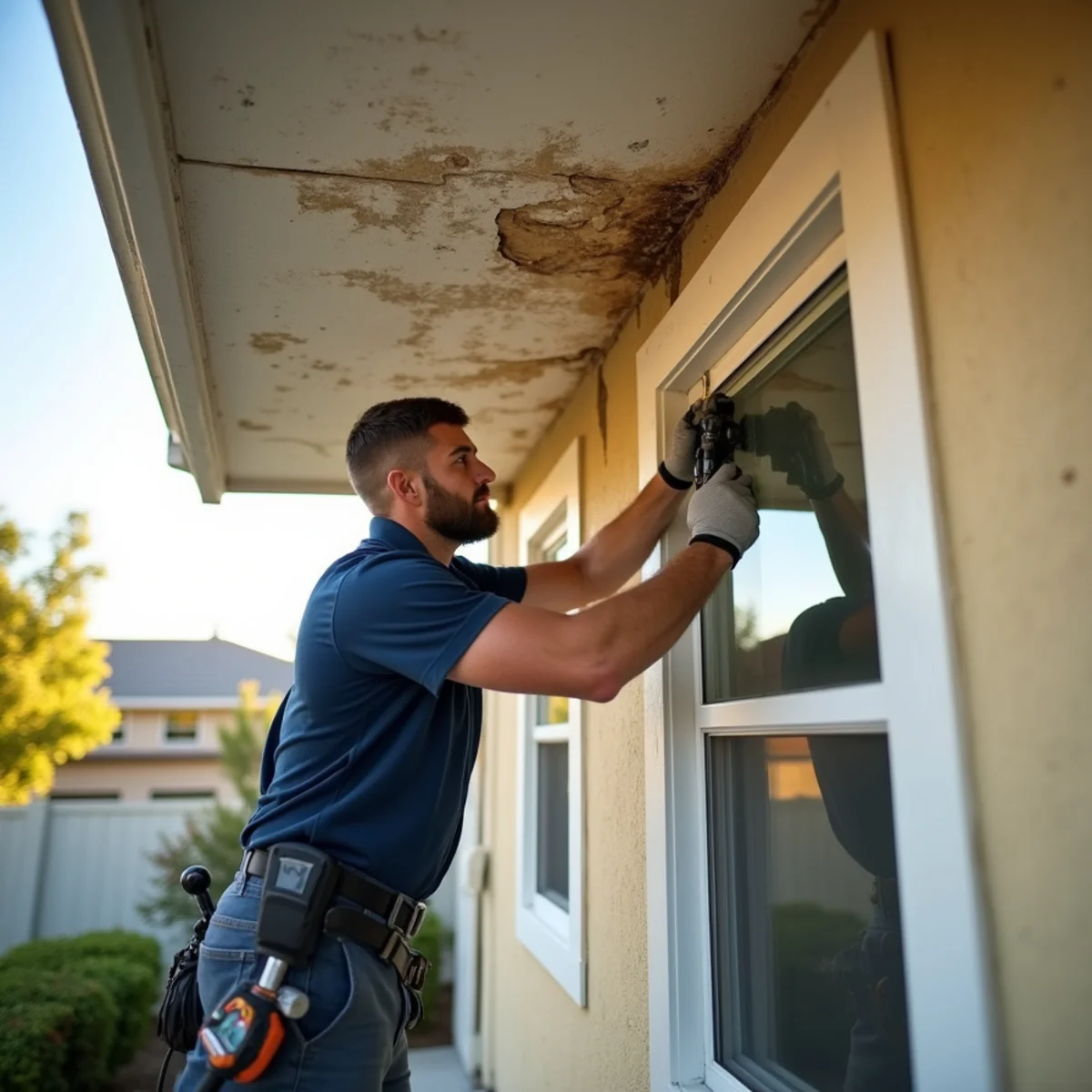
24/7 Emergency Service
Ceiling Water Damage Repair in San Ramon, CA
A bulging ceiling is holding water. Stay out from under it.
- 24/7 emergency crews — nights, weekends and holidays
- 60-minute emergency response across San Ramon
- Free on-site estimate
- We bill your insurance directly
24/7 Emergency Service
Answered live, any hour
60-Minute Response
Across all of San Ramon
IICRC Certified
Works to the S500 standard
Insurance Billed Direct
Daily moisture logs
A water stain on a ceiling is the visible bottom edge of a much larger problem. Water spreads laterally across the top of the drywall before it soaks through, so by the time you can see discoloration, the insulation, the framing and the drywall above have typically been wet for a while — and the wet area up there is considerably wider than the stain down here.
Ceiling damage is also the one type of water damage with an immediate safety dimension. Drywall holds a surprising amount of water before it fails, and when it does fail it comes down as a sheet rather than a drip. A visibly sagging or bulging ceiling is a loaded surface, and the correct response is to get everyone out from under it and let someone relieve it deliberately — not to poke it with a broom handle and hope.
The repair sequence matters more here than almost anywhere else, because the temptation to skip to the visible part is strongest. Find the source. Dry the cavity, including the insulation and framing. Then repair the ceiling. Painting over a stain without doing the first two steps produces a ceiling that stains again in the same spot, and a wall cavity quietly growing mold in the meantime.
Request help with ceiling water damage
Tell us what happened. We respond within one business hour — or call now for a 24/7 emergency dispatch.
Know the signs
What Different Ceiling Symptoms Are Telling You
A brown or yellow ring with a defined edge
A leak that has wet the drywall and then dried, at least once. The ring is a mineral tide line. If it has multiple rings, the leak is intermittent — commonly a roof or a shower pan used at intervals.
A stain that is actively growing while you watch
The leak is running right now. This is an emergency call, not a Monday morning call.
A bulging, sagging or heavy-looking area
That pocket is holding water. It can drop as a full sheet with no further warning. Evacuate the area beneath it and let a crew relieve it under control.
Paint bubbling or peeling in a patch
Moisture pushing out through the finish from behind. Usually a slower, ongoing leak rather than a sudden one.
Popcorn or textured ceiling discoloring and flaking
Common in San Ramon’s 1970s and 80s housing. Important: textured ceilings from that era may contain asbestos, so they should be tested before anyone disturbs them.
Stains that follow a straight line
Water running along a joist, a pipe run or a duct before it soaks through. The actual source is often several feet away from where you see the stain.
A stain directly beneath an upstairs bathroom
The most common ceiling leak we see. Usually a wax ring, a shower pan, a tub-surround seal, or a supply connection under the vanity.
Our process
How We Repair Ceiling Water Damage
 1
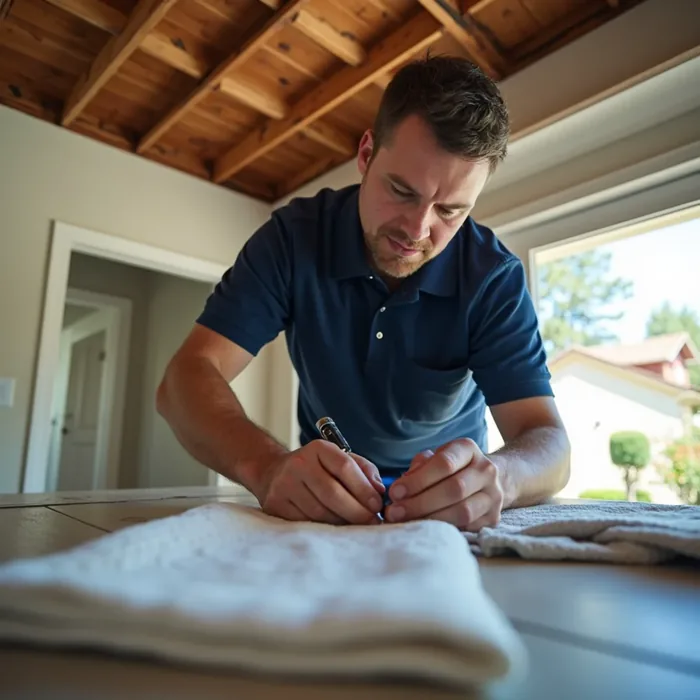
1Make the area safe
On arrivalClear the room beneath, and if the ceiling is holding water, relieve it in a controlled way with containment below rather than allowing an uncontrolled collapse.
 2
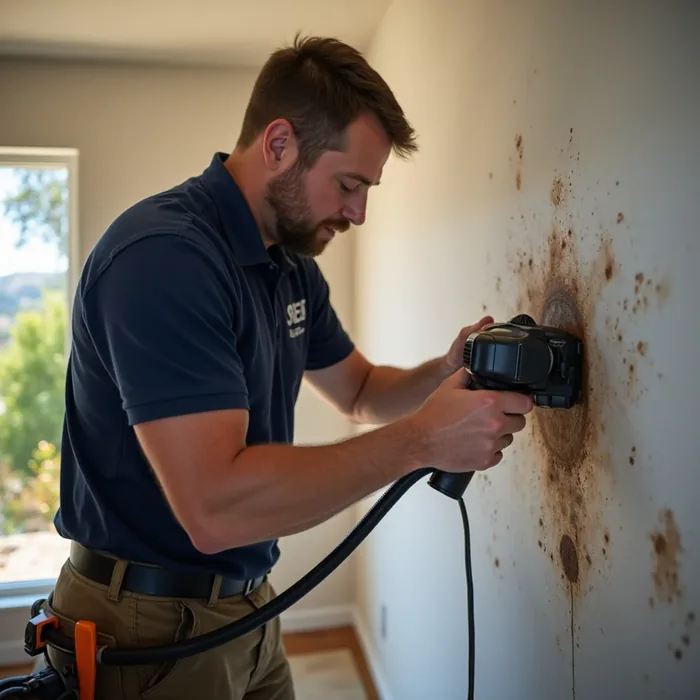
2Find the actual source
30–90 minutesThermal imaging and moisture mapping from below, plus access from above where possible — attic, upstairs bathroom, or the floor cavity. Water travels, so the stain is a symptom, not an address.
 3
3Stop the leak
1–3 hoursEmergency tarping for a roof source, isolation for a plumbing source, and coordination of the permanent repair. Nothing else proceeds until the water is stopped.
- 4
Open, remove and extract
2–5 hoursSaturated ceiling drywall and wet insulation come out. Blown or batt insulation that has taken water has lost its performance and holds moisture against the framing — it does not dry in place.
- 5
Dry the cavity and the framing
3–5 daysDirected airflow into the open cavity and dehumidification in the room, monitored daily until framing and adjacent materials meet a dry standard.
- 6
Rebuild and finish
2–4 daysNew drywall, taped and finished, texture matched to the existing ceiling, primed with a stain-blocking primer and painted. Matching an existing texture well is a real skill and it is where most DIY ceiling repairs become visible forever.
What you actually get
What Ceiling Repair Includes
The area made safe
Room cleared, and if the ceiling is holding water it is relieved in a controlled way with containment below rather than left to collapse.
The actual source found
Thermal imaging and moisture mapping from below, plus access from above where possible. Water travels along framing, so the stain is a symptom rather than an address.
The leak stopped
Emergency tarping for a roof source, isolation for a plumbing source, and the permanent repair coordinated. Nothing else proceeds first.
Wet insulation removed
Blown or batt insulation that has taken water has lost its performance permanently and holds moisture against the framing. It comes out.
Cavity and framing dried to standard
Directed airflow into the opened cavity and dehumidification in the room, monitored daily until framing and adjacent materials meet the dry standard.
Texture matched, not just patched
New drywall taped and finished, texture matched to the existing ceiling, sealed with a stain-blocking primer and painted. Matching texture well is where most repairs become permanently visible.
Asbestos testing where the era requires it
Textured ceilings from before the early 1980s are tested before anyone cuts or scrapes.
Why San Ramon Water Damage Pros
Why Ceilings Are Not a Paint Job
We find the source before we open anything
Water runs along joists, pipes and ducts before it soaks through. The source is frequently several feet from the stain and sometimes across the room.
We will not paint over a live leak
Stain-blocking primer goes on after the cavity is verified dry, not instead of drying it. That is the difference between a repair and a delay.
We test pre-1980s texture as standard
Much of Central San Ramon, Broadmoor, Old Ranch and Crow Canyon has popcorn ceilings that may contain asbestos. Undisturbed it is not a hazard; cutting it is exactly the disturbance that matters.
Texture matching is a real skill
Knockdown, orange peel and skip trowel matched by people who do it daily, so the repair does not announce itself for the next twenty years.
Need ceiling water damage in San Ramon right now?
We answer live 24 hours a day and dispatch immediately. The first hour decides how much of your property we can save.
- Free on-site estimate
- We bill your insurance directly
- IICRC-certified technicians
Where Ceiling Leaks Come From in San Ramon Homes
The source distribution is fairly predictable, and it shifts by neighborhood age. In the two-story homes of Dougherty Valley, Windemere and Gale Ranch, upstairs bathrooms and second-floor laundry rooms dominate — and a meaningful number of those homes have the water heater on an upper-floor platform, which turns a tank failure into a ceiling event across multiple rooms rather than a garage cleanup.
In the older single-story and two-story stock of Central San Ramon, Broadmoor and Crow Canyon, roof and flashing leaks are proportionally more common, along with condensation problems from bath fans that terminate in the attic instead of through the roof.
- Upstairs bathroom: wax ring failure, shower pan leak, tub-surround seal, or a supply line under the vanity.
- Second-floor laundry: washing machine supply hose or drain line — the highest-volume failure in this list.
- Upper-floor water heater platform: a split tank drains through the ceiling into the rooms below.
- Roof and flashing: especially after Diablo wind season loosens shingles and chimney or vent flashing.
- HVAC condensate: a blocked drain line or a rusted-out drain pan on an attic air handler.
- Bath fan venting into the attic instead of outside, condensing on cold sheathing and dripping back down.
- Ice maker or refrigerator supply line on an upper floor, running behind a wall.
Asbestos in Older Textured Ceilings
This is worth stating plainly because it affects a lot of San Ramon housing. Textured "popcorn" ceilings installed before the early 1980s may contain asbestos, and a great deal of the city’s original 1970s and early-80s tract housing has exactly that finish. Undisturbed, it is not a hazard. Cut, scraped, sanded or torn out during a water damage repair, it can be.
The correct process is to test before disturbing it. If a sample comes back positive, the removal is handled by a licensed asbestos abatement contractor under proper containment before restoration proceeds. It adds a step and some cost, and it is not optional. Any contractor who offers to just cut out a section of 1970s popcorn ceiling without testing it is telling you something important about how they work.
Honest pricing
What Ceiling Repair Costs Depend On
Size of the affected area
A two-foot patch is straightforward. A full ceiling plane across a great room is a different job, and sometimes a full-plane replacement produces a better result than a large patch.
The source of the leak
A wax ring is inexpensive to fix. A roof or a slab-adjacent plumbing failure carries its own significant repair scope before the ceiling work starts.
Insulation replacement
Wet attic insulation over the affected area has to be removed and replaced. Homeowners routinely underestimate this line item.
Texture matching
Knockdown, orange peel and skip trowel can be matched well by someone who does it daily. Popcorn is harder, and asbestos testing may be required before it is touched at all.
Ceiling height and access
Vaulted and two-story entry ceilings need staging or lifts, which adds labor to every phase of the work.
Painting scope
A patch rarely blends invisibly into an aged painted surface. Painting corner to corner on the affected plane is often the only way to get a result you will not notice forever.
Where we provide this service
Ceiling Water Damage across San Ramon and the Tri-Valley
FAQ
Ceiling Water Damage questions we get asked
We would rather you did not. The common advice is to relieve it with a screwdriver, and restoration crews do exactly that — but you cannot judge from below how much water is up there, and the small hole often becomes the failure point for a much larger saturated section coming down at once, along with wet insulation. Get everyone out from under it, move what you can from the edges of the room, and tell us it is bulging when you call so we arrive ready to relieve it with containment underneath.
Get everyone out from under it and keep them out. That bulge is a pocket of water in the drywall and it can release as a full sheet without warning. Do not puncture it yourself unless you are prepared for everything above it to come down at once. Move furniture out of the room if you can do so from the edges, and call.
Only after the source is fixed and the cavity is verified dry — and then with a stain-blocking primer, because water stains bleed through standard paint. Painting first is the most common mistake we see; it hides the evidence while the leak continues and the framing above stays wet.
Often you cannot from below, which is the point of professional diagnosis. Water runs along joists, pipes and ducts before it soaks through, so the source can be several feet from the stain — and sometimes on the other side of the room. We use thermal imaging and moisture mapping plus access from above to find it before anyone opens the ceiling.
If the home was built before the early 1980s — which covers a large share of Central San Ramon, Broadmoor, Old Ranch and Crow Canyon — then yes, test before disturbing it. Undisturbed it is not a hazard; cutting or scraping it is exactly the disturbance that matters. A positive result means licensed abatement before restoration continues.
You might also need
Related services
Roof Leak Water Damage Restoration
Tarp the opening, dry the attic and the ceilings below, and replace the insulation that quietly lost its R-value.
Learn moreLeak Detection & Repair Coordination
Acoustic, thermal and pressure testing that locates the leak before anyone opens a wall or a slab.
Learn moreStructural Drying & Dehumidification
Engineered drying with commercial air movers and dehumidifiers, verified daily against a measured dry standard — not a guess.
Learn moreGet ceiling water damage handled properly
Free on-site estimate, written scope before any reconstruction, and direct insurance billing with documentation your adjuster can actually use.
- Free on-site estimate
- We bill your insurance directly
- IICRC-certified technicians