

24/7 Emergency Service
Water Damage Restoration in Contra Costa County, CA
From our San Ramon Valley Blvd base we reach the San Ramon Valley in minutes and most of central Contra Costa County inside 30 to 40.
- 24/7 emergency crews — nights, weekends and holidays
- Free on-site estimate
- IICRC-certified technicians
- We bill your insurance directly
24/7 Emergency Service
Answered live, any hour
60-Minute Response
Across all of San Ramon
IICRC Certified
Works to the S500 standard
Insurance Billed Direct
Daily moisture logs
County-wide coverage
Water damage restoration in Contra Costa County
Contra Costa County covers an enormous range of building conditions, and water damage here looks completely different depending on which part of it you are standing in. The 1940s and 50s flatland stock in Martinez and Pleasant Hill has galvanized supply lines and clay sewer laterals that are simply out of service life. The foothill communities — Orinda, Moraga, Lafayette and the San Ramon Valley — deal with hillside drainage, saturated slope runoff and canyon fire-and-flood interaction. Out toward the Delta, Antioch and Brentwood contend with a high water table and soils that behave differently from the valley clay we work in every day.
The county-level infrastructure matters more than most homeowners realize. Contra Costa County Flood Control and Water Conservation District maintains the engineered channels and detention basins that carry storm flow through developed areas, including the San Ramon Creek system and the basins protecting the central San Ramon corridor. Those facilities are why a two-day atmospheric river does not put water into far more homes than it does — and they are also why the properties that do flood tend to be the ones where private drainage, grading or gutters failed rather than the public system.
Water damage help in Contra Costa County
Tell us what happened and we will respond within one business hour — or call now for 24/7 emergency dispatch.
Local risk profile
Water Damage Risk Across Contra Costa County
Three distinct risk geographies sit inside one county, and the failure patterns follow them closely. In the San Ramon Valley and the Tri-Valley generally, very hard EBMUD water and expansive clay soils drive slab leaks and pinhole copper failures. In the Lamorinda foothills and the canyon communities, wildfire burn scars and steep terrain combine into debris-flow and runoff exposure during winter storms. Along the northern waterfront and east toward the Delta, older housing stock and high groundwater produce a different mix again.
What is common countywide is timing. Roughly 20 inches of rain falls in an average year and nearly all of it lands between November and March, frequently concentrated into a handful of atmospheric river events. That compresses the county’s entire flood risk into a short season with very high peak intensity.
- Tri-Valley and San Ramon Valley: expansive clay soil movement, very hard water, slab-on-grade housing at peak slab-leak age.
- Lamorinda and canyon communities: Very High Fire Hazard Severity Zones with post-fire debris flow and slope runoff exposure.
- Central county flatlands: 1950s–70s tract housing with galvanized plumbing and aging sewer laterals.
- East county and Delta edge: high water table, sump-pump dependence and hydrostatic pressure at slabs.
- Countywide: rainfall concentrated November through March, delivered in short, intense storm events.
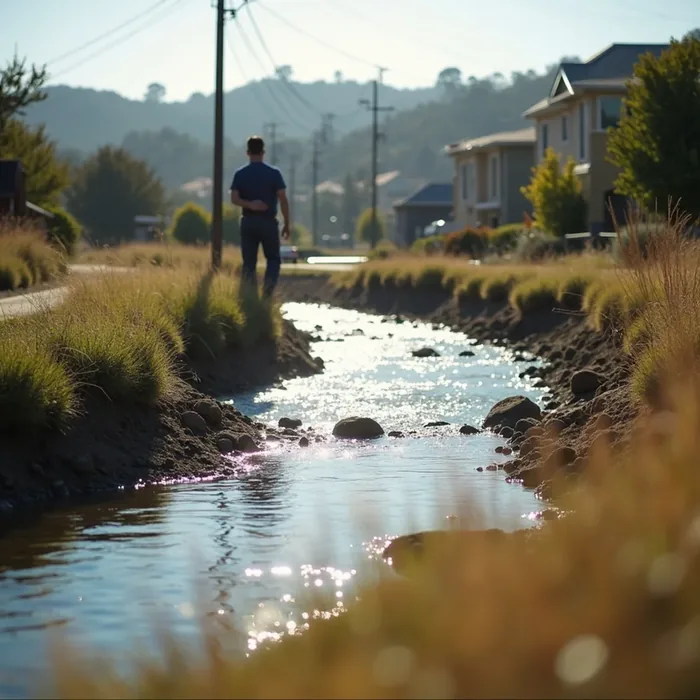
Where We Work in Contra Costa County
Our home ground is the San Ramon Valley — San Ramon, Danville, Alamo and Blackhawk — where we hold a 60-minute response commitment and are usually well inside it. We work north through Walnut Creek, Lafayette and Pleasant Hill, east to Concord and Martinez, and out to Brentwood and Antioch for larger losses. Bishop Ranch and the Crow Canyon corridor keep us in the commercial side of the county regularly.
Landmarks & corridors we work
- San Ramon Creek flood control channel
- Bishop Ranch business park
- Iron Horse Regional Trail corridor
- Mount Diablo State Park
- I-680 and Highway 24 corridors
- Lafayette Reservoir
Why this matters: Contra Costa County Flood Control manages the San Ramon Creek channel and the detention basins that keep storm runoff out of the central San Ramon corridor.
From the job log
Three jobs that define county-wide work
The first-storm drainage failure
A yard inlet buried under a season of leaf litter backs up during the first real rain, and water sheets toward the lowest opening in the building — usually a garage or a lower-level door. The structural damage is minor; the reason it happened is ten minutes of maintenance nobody did in October.
The unincorporated-parcel job
A property outside city limits, often on septic and sometimes on a well, where restoration has to route through county permitting rather than a city building department. The drying is standard. Establishing which authority signs off before reconstruction starts is what keeps the schedule honest.
The multi-jurisdiction commercial loss
A tenant space where the building owner, the tenant and two carriers all have a stake, and the property sits in one jurisdiction while the management company sits in another. We document scope per party from the first visit, because that record is what stops a shared loss becoming a dispute.
Water damage in Contra Costa County? Call now.
From our San Ramon Valley Blvd base we reach the San Ramon Valley in minutes and most of central Contra Costa County inside 30 to 40.
- Free on-site estimate
- We bill your insurance directly
- IICRC-certified technicians
What we do here
The services Contra Costa County property owners call us for
Water Damage Restoration
Full-service restoration from the first extraction pass through final moisture verification — documented for your insurer at every step.
Learn more24/7 Emergency Water Removal
A real person answers at 3 a.m., a truck rolls immediately, and we talk you through the shutoff while it does.
Learn moreFlood Cleanup
Storm and creek flooding handled as the contaminated loss it is — contained extraction, disposal, sanitizing and full structural drying.
Learn moreMold Remediation
Containment-first remediation that removes growth and fixes the moisture source — because mold that comes back was never really removed.
Learn moreTiming
One county, several different risk calendars
Contra Costa is wide enough that the same storm produces different failures in different parts of it. A November atmospheric river fills the flood control channels in the central valley, saturates hillside slopes in the western foothills, and raises an already high water table on the eastern Delta edge — three separate problems from one weather event.
That is why we scope by location rather than by season alone. Knowing which part of the county a property sits in tells us what the water is likely to be doing before anyone arrives.
- 1
October to December — the first storms
The heaviest concentration of calls in the year. Drainage that has sat unused since March gets asked to work at full capacity, and blocked channels, clogged area drains and buried yard inlets all fail at once. Countywide, this window produces more seepage and surface-water calls than the rest of the year combined.
- 2
January to March — saturation
By midwinter the ground is holding water rather than absorbing it. Hydrostatic pressure through slabs and below-grade walls peaks here, and the foothill communities see the slope-failure and retaining-wall seepage that follows several weeks of accumulated rain rather than a single storm.
- 3
June to September — the dry-season failures
Supply-side rather than weather-driven. Irrigation runs at maximum, soils shrink away from foundations and buried lines, and water heaters and appliance connectors fail on their own schedule. These are the quiet losses that run for days in an empty holiday house before anyone finds them.
FAQ
Contra Costa County water damage questions
Yes, and it matters for scheduling rather than for the drying work. An incorporated city issues its own permits, while unincorporated pockets route through the county — which changes who inspects a structural repair or a sewer lateral replacement. We establish which authority applies before reconstruction starts rather than discovering it partway through.
We serve the county broadly, with response times that scale by distance from our San Ramon base. The San Ramon Valley carries our 60-minute commitment. Walnut Creek, Lafayette, Pleasant Hill and Concord typically run 20 to 30 minutes. Martinez, Brentwood and Antioch we serve for larger losses, generally 35 to 45 minutes out.
The district maintains engineered channels and detention basins that carry storm flow through developed areas, and they do a great deal of work. But public flood control does not address private drainage — grading, gutters, downspout discharge and yard drains are the homeowner’s responsibility, and in our experience those are what actually fail during a major storm.
Because geology, housing age and terrain all change dramatically over short distances. Expansive clay and very hard water drive slab leaks in the Tri-Valley; steep terrain and burn scars drive runoff and debris flow in Lamorinda; high groundwater and 1940s–60s housing stock drive different failures toward the Delta.
Why call us
What you get on a Contra Costa County job
IICRC-certified, working to S500
Water category and damage class determined on site and recorded in writing — the same standard your adjuster reads from.
Licensed, insured, background-checked
A California CSLB licence you can verify yourself, general liability and workers’ compensation cover, and crews screened before they enter your home.
Daily moisture readings
A dry standard measured from unaffected materials in your own building, and the full drying log handed over at completion.
Insurance billed direct
Documentation built for the adjuster from the first hour, plus a written scope before any reconstruction begins.
Water moving right now? Do these three things first.
- 1. Shut off the main water valve — garage, exterior wall, or the box near the street.
- 2. Cut power to the affected circuits, only if you can reach the panel from a dry spot.
- 3. Photograph everything before you move it, including the failed pipe or fitting.
Then call — we stay on the line while the truck is already moving.
Nearby areas we also serve
Guides for Contra Costa County property owners
Get help now
Serving Contra Costa County, CA from San Ramon Valley Blvd
San Ramon Water Damage Pros
2551 San Ramon Valley Blvd
San Ramon, CA 94583
Open 24 hours a day, 7 days a week
Office: Mon–Fri, 8:00 AM – 6:00 PM
24/7 emergency dispatch
24/7 emergency crews — nights, weekends and holidays. Free on-site estimate, written scope before any rebuild, and we bill your insurance directly.
- Free on-site estimate
- We bill your insurance directly
- IICRC-certified technicians