

24/7 Emergency Service
Leak Detection Services in San Ramon, CA
Find it precisely, open one small area, fix it once.
- 24/7 emergency crews — nights, weekends and holidays
- 60-minute emergency response across San Ramon
- Free on-site estimate
- We bill your insurance directly
24/7 Emergency Service
Answered live, any hour
60-Minute Response
Across all of San Ramon
IICRC Certified
Works to the S500 standard
Insurance Billed Direct
Daily moisture logs
The expensive part of a hidden leak is rarely the repair. It is the exploratory demolition that happens when nobody knows exactly where the leak is — three holes in a wall, a section of flooring lifted, a slab trenched in the wrong place. Accurate detection is what turns that into a single, correctly-placed opening.
We locate leaks non-invasively using the tools the job calls for: acoustic listening equipment that picks up the specific frequency of pressurized water escaping a line, thermal imaging that reads the temperature differential a hot-side leak creates through concrete or drywall, tracer gas for lines that will not talk acoustically, and pressure isolation testing to prove which system is losing water in the first place.
San Ramon gives us a lot of practice. Hard EBMUD water at 16 to 18 grains per gallon drives pitting corrosion in copper, producing the pinhole leaks that are endemic in 1980s and 90s homes. The valley’s expansive clay soil swells and shrinks seasonally, cycling stress into slabs and the supply lines running beneath them. And in the 1970s slab-on-grade tracts across Central San Ramon, Old Ranch, Broadmoor and West San Ramon, original under-slab plumbing is now well past the age where failures become common.
Request help with leak detection
Tell us what happened. We respond within one business hour — or call now for a 24/7 emergency dispatch.
Know the signs
Signs of a Hidden Water Leak
A water bill that jumped with no change in usage
The most reliable early indicator there is. A continuous leak runs 24 hours a day, and EBMUD billing will show it well before you see any water.
The sound of running water when everything is off
Stand in a quiet house with every fixture closed. A faint hiss or trickle in a wall or under the floor is a pressurized line losing water.
A warm spot on the floor
A hot-side slab leak heats the concrete above it. This is one of the few slab leak symptoms you can find with your bare feet, and it is quite specific.
Low water pressure that developed gradually
Pressure lost to a leak somewhere in the system shows up at the fixtures, usually worsening slowly enough that people adjust to it.
Cracks appearing in flooring or drywall
Water under a slab softens the soil beneath it, and in San Ramon’s expansive clay that produces differential movement — which shows up as cracks in tile grout, flooring and wall corners.
A persistently damp or unusually green patch in the yard
An irrigation or service line leak surfaces as a wet area that stays wet between waterings, or grass that is noticeably more vigorous than everything around it.
The meter dial moves with everything shut off
Shut every fixture and watch the low-flow indicator on your EBMUD meter. Any movement over 15 minutes means water is leaving the system somewhere.
Our process
How We Find a Hidden Leak
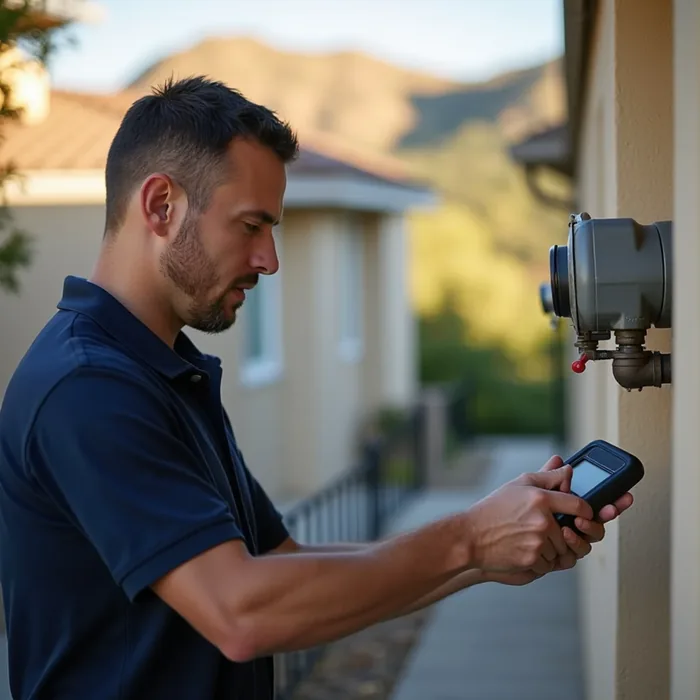 1
1Interview and meter check
20–30 minutesWe start with what you have noticed and when, then verify at the meter with all fixtures closed. That single test tells us whether we are chasing a supply leak or something else entirely.
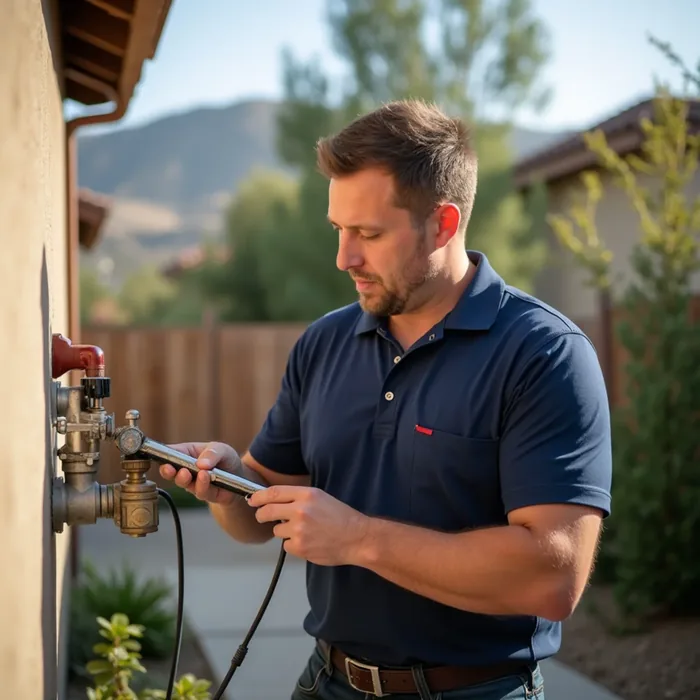 2
2Isolation testing
30–60 minutesBy isolating sections of the system and pressure testing them independently, we narrow the leak to a specific run — irrigation, service line, hot side or cold side — before any locating equipment comes out.
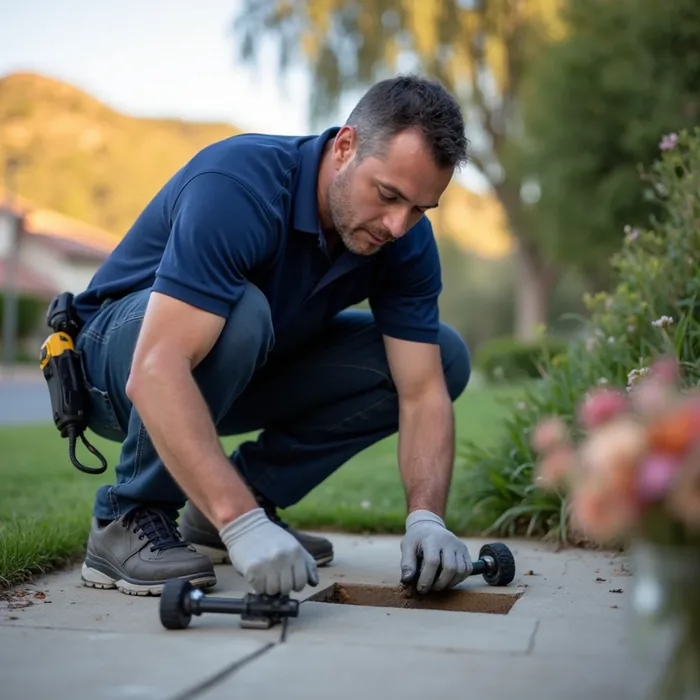 3
3Acoustic location
30–90 minutesGround microphones and amplified listening equipment pick up the sound of pressurized water escaping. On slab leaks this typically narrows the position to within a small radius.
- 4
Thermal imaging
20–40 minutesAn infrared camera reads the temperature signature a hot-water leak leaves through concrete, flooring or drywall, and confirms the acoustic result from a second, independent direction.
- 5
Tracer gas where needed
45–90 minutesFor quiet leaks, small leaks, or lines under thick slab that will not produce a usable acoustic signal, we introduce an inert tracer gas and detect where it surfaces.
- 6
Mark, document and coordinate the repair
Same visitWe mark the location, document it with photographs and readings for your insurance file, and coordinate the plumbing repair — then handle the drying and restoration of whatever the leak damaged.
What you actually get
What a Leak Detection Visit Includes
Interview and meter verification
What you have noticed and when, then a meter test with everything closed. That single test establishes whether we are chasing a supply leak at all.
System isolation testing
Sections pressure-tested independently to narrow the loss to a specific run — irrigation, service line, hot side or cold side — before any locating equipment comes out.
Acoustic location
Ground microphones and amplified listening equipment picking up pressurised water escaping the line, typically narrowing a slab leak to a small radius.
Thermal confirmation
An infrared camera reading the temperature signature a hot-side leak leaves through concrete, flooring or drywall — an independent second method.
Tracer gas where the signal is poor
For quiet leaks, cold-side leaks or thick slabs, an inert tracer gas introduced and detected where it surfaces.
Marked location and written findings
The position marked on site and documented with photographs and readings for your insurance file, plus coordination of the plumbing repair.
Why San Ramon Water Damage Pros
Why Precise Location Saves Real Money
Two independent methods before we cut
When the acoustic peak and the thermal plume agree, confidence is high enough to open one small area rather than three.
We isolate before we listen
Going straight to listening is how an irrigation leak gets located as a slab leak. Isolation testing comes first, every time.
We know why Tri-Valley pipes fail
EBMUD water at 16 to 18 grains per gallon drives pitting corrosion in copper, and expansive clay cycles stress into under-slab lines. That context shapes where we look.
Honest repair-versus-repipe advice
One failure in sound pipe is a spot repair. A third pinhole in two years is a system telling you something, and we will say so even though the smaller job is easier to sell.
Need leak detection in San Ramon right now?
We answer live 24 hours a day and dispatch immediately. The first hour decides how much of your property we can save.
- Free on-site estimate
- We bill your insurance directly
- IICRC-certified technicians
Slab Leaks: San Ramon’s Signature Hidden Leak
A large share of San Ramon housing is slab-on-grade, with supply lines running through or beneath the concrete. When one of those lines fails, the water has nowhere obvious to go — it saturates the sub-slab fill, softens the soil, and often runs for weeks before anyone notices anything more than a warm floor and a high bill.
Two local conditions make this worse than average. Hard water attacks copper from the inside, producing pinhole failures in lines that were installed correctly and have simply been in service too long in this water. And expansive clay soil cycles through swelling and shrinking with the seasons, applying repeated mechanical stress to lines that are held rigidly in concrete. The combination is why 1970s and 80s slab-on-grade neighborhoods here produce so much of this work.
- Warm spots on the floor — the most specific single symptom of a hot-side slab leak.
- Running water audible with everything shut off.
- Unexplained EBMUD bill increases, month over month.
- Cracks in tile grout, flooring seams or wall corners as sub-slab soil moves.
- A damp or discolored patch on a slab floor, sometimes with efflorescence at the edge.
What Happens After We Find It
Detection is the beginning of the job, not the end. Once we have the leak marked, there are usually two or three legitimate repair paths and they differ substantially in cost and disruption — a spot repair through the slab, a reroute of the affected line through the wall or attic, or a partial or whole-house repipe if the piping has reached the point where failures will keep coming.
We will tell you honestly which of those makes sense for your house. A single failure in an otherwise sound copper system is a spot repair. A third pinhole leak in two years in an 1985 home on Tri-Valley water is a system that is telling you something, and spending repeatedly on spot repairs is usually the more expensive path.
From there we coordinate the licensed plumbing repair and handle everything downstream of it: extracting water that has accumulated, drying the affected structure to a verified standard, remediating any growth that started, and rebuilding what was opened.
Honest pricing
What Leak Detection Costs Depend On
Type of leak
A supply line under a slab, a drain line, an irrigation line and a pool line each need different equipment and different amounts of time.
Accessibility
A leak under an open tile floor is straightforward. One under built-in cabinetry, a stair landing or a finished lower level takes longer to isolate.
How many systems need isolating
Homes with irrigation zones, a pool, a water feature and multiple hose bibs take more isolation testing to narrow down.
Slab thickness and floor covering
Thick slabs and dense finishes attenuate the acoustic signal, sometimes requiring tracer gas as a second method.
Whether damage has already occurred
If the leak has already wet flooring or wall assemblies, extraction, drying and restoration become part of the scope alongside the detection.
Where we provide this service
Leak Detection across San Ramon and the Tri-Valley
FAQ
Leak Detection questions we get asked
In the large majority of cases, yes — a meter test plus isolation, acoustic location and thermal confirmation usually pins a supply leak within a single visit. The exceptions are intermittent leaks that are not running while we are there, very small losses under thick slab, and situations where several systems are losing water at once. When that happens we tell you what we ruled out, what we still suspect, and what the next step costs before we do it.
We use acoustic listening equipment to hear pressurized water escaping the line, thermal imaging to read the heat signature of a hot-side leak through the slab, tracer gas for quiet leaks, and pressure isolation to confirm which system is losing water. The point of all of it is to open one small, correctly-placed area instead of guessing.
Shut off every fixture and appliance that uses water, then watch the low-flow indicator on your EBMUD meter for about 15 minutes. If it moves at all, water is leaving the system somewhere. Combine that with an unexplained bill increase and you have strong evidence worth acting on.
Tri-Valley water runs 16 to 18 grains per gallon — very hard — and that mineral content drives pitting corrosion inside copper supply lines over time. The failures show up as pinhole leaks, and they cluster in homes from the 1980s and 90s where the original copper has now been in service in this water for decades.
We locate and document the leak and coordinate the licensed plumbing repair, then handle everything on the restoration side — extraction, structural drying to a verified standard, any mold remediation the leak caused, and rebuilding what was opened. One point of contact from detection through finished repair.
You might also need
Related services
Slab Leak Water Damage Restoration
The valley’s signature hidden leak. Detection, drying the slab and the walls above it, and an honest repair-versus-repipe recommendation.
Learn moreMold Remediation
Containment-first remediation that removes growth and fixes the moisture source — because mold that comes back was never really removed.
Learn moreCeiling Water Damage Repair
Find the source, dry the cavity, then repair — patching a stained ceiling without doing the first two is why it comes back.
Learn moreGet leak detection handled properly
Free on-site estimate, written scope before any reconstruction, and direct insurance billing with documentation your adjuster can actually use.
- Free on-site estimate
- We bill your insurance directly
- IICRC-certified technicians