
24/7 Emergency Service
Water Damage Restoration Services in San Ramon, CA
All 17 services we run across San Ramon and the Tri-Valley — emergency response through full reconstruction.
24/7 Emergency Service
Answered live, any hour
60-Minute Response
Across all of San Ramon
IICRC Certified
Works to the S500 standard
Insurance Billed Direct
Daily moisture logs
One contractor, whole job
Every stage of a water loss, under one license
A water loss does not arrive labelled. You find standing water, or a stain spreading across a ceiling, or a smell that was not there last month — and the trade name for it is the last thing on your mind. So the honest answer to “which service do I need” is usually: call, describe what you can see, and let the assessment sort it out. The first hour of work is close to identical whichever page brought you here.
What does change between them is everything after that hour. Sewage is handled to a different standard than a clean supply line. A slab leak needs locating before anything is opened. Storm water carries whatever the ground it crossed was holding. Each page below sets out how that specific job is actually run — the equipment, the sequence and the cost drivers particular to it — rather than repeating a generic restoration pitch seventeen times.
All of it runs from one place. We assess, mitigate, remediate where it is warranted and rebuild, with a single documented file behind it. That matters most at the seam between drying and repair, which is exactly where jobs split between two companies tend to stall.
Standing water right now? Call us.
A person answers 24 hours a day and a crew is dispatched immediately. The first hour decides how much of your home we can save.
- Free on-site estimate
- We bill your insurance directly
- IICRC-certified technicians
Start here
What you can see, and where it points
- Standing water on the floor right nowAnything more than a damp patch needs mechanical extraction before it soaks into the subfloor. Every hour it sits, it moves further under walls and cabinets.Emergency Water Removal
- A pipe has burst and I have shut off the waterSource is controlled, damage is not. The wall cavity and floor assembly around the failure are wet and need opening, drying and verifying.Burst Pipe Cleanup
- A brown stain or bulge in the ceilingWater has already passed through the floor above or the roof. The stain is the low point, not the source — the leak is usually somewhere else entirely.Ceiling Water Damage
- Water in the basement or crawl spaceBelow-grade water is a drainage and pumping problem before it is a drying problem, and the crawl space keeps feeding humidity upstairs until it is dealt with.Basement & Crawl Space
- A warm spot on the floor or water running with everything offClassic slab leak signature. The pipe is inside or under the concrete, so locating it accurately matters more than anything else you do first.Slab Leak Damage
- Sewage backing up through a drain or toiletCategory 3 water under the IICRC S500 standard. Stop using water anywhere in the building, keep people out of the room, and do not attempt to clean it yourself.Sewage Cleanup
- A musty smell, or visible growth on a wallSomething has been wet long enough to support growth. The remediation is straightforward; finding and stopping the moisture source is the part that decides whether it returns.Mold Remediation
- The water bill jumped and I cannot see whyA hidden supply leak — under a slab, behind a wall or on the irrigation system. Non-invasive detection finds it before anything gets opened up.Leak Detection
- The water heater has let go in the garageUp to fifty gallons plus whatever kept feeding the tank. It rarely stays in the garage — water tracks under the shared wall into the rooms beside it.Water Heater Leaks
- Rain is getting in during stormsRoof, flashing or envelope failure. It needs stabilising before the next storm, then the assemblies underneath need drying rather than just repainting.Roof Leak Damage
1 service
Complete Water Damage Restoration
6 services
Core Restoration Services
Water Extraction & Removal
Truck-mounted and portable extraction that pulls water out mechanically — the fastest, cheapest way to stop a loss from spreading.
Learn moreStructural Drying & Dehumidification
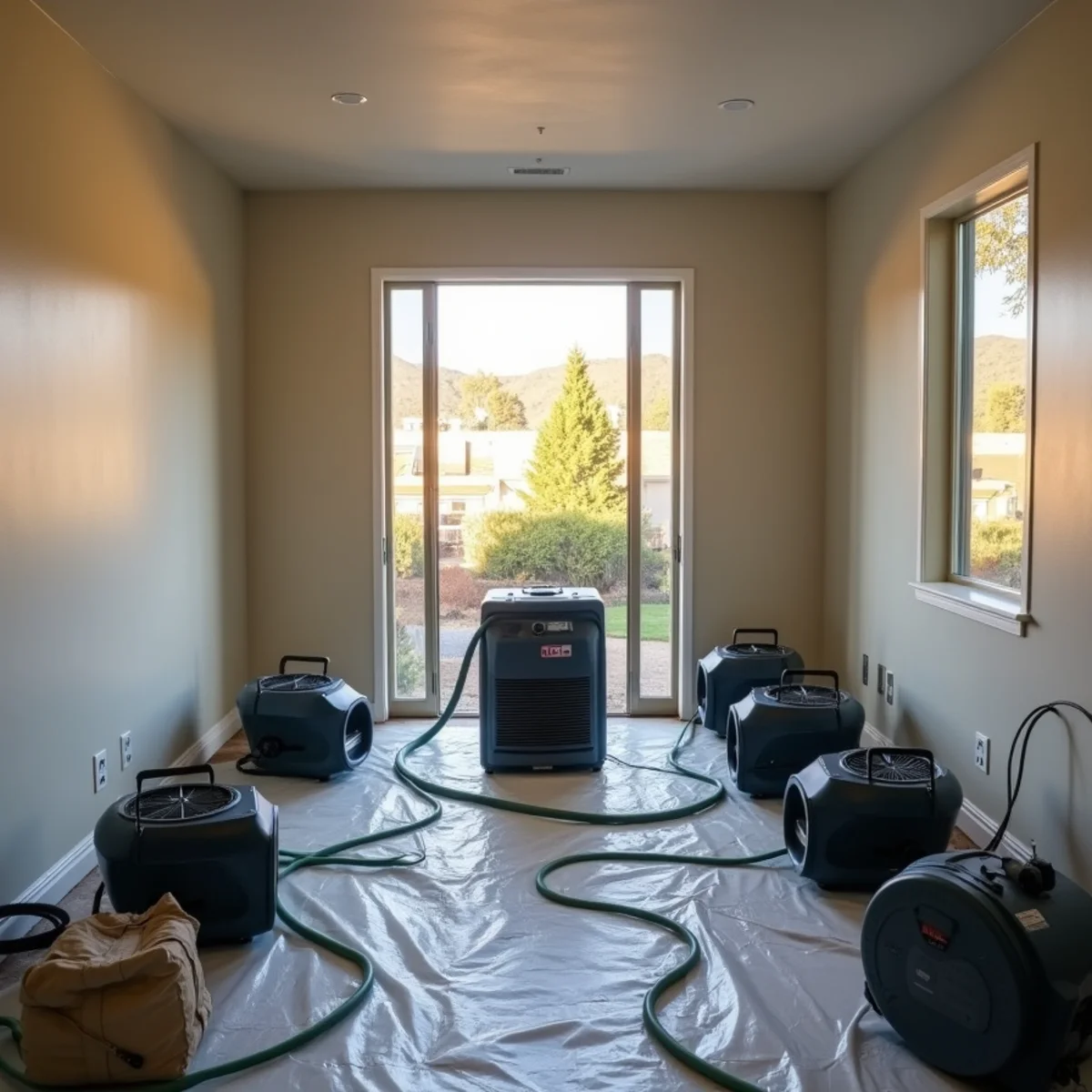
Engineered drying with commercial air movers and dehumidifiers, verified daily against a measured dry standard — not a guess.
Learn moreFlood Cleanup
Storm and creek flooding handled as the contaminated loss it is — contained extraction, disposal, sanitizing and full structural drying.
Learn moreSewage Cleanup & Backup Removal
Category 3 contamination handled properly — containment, PPE, disposal, disinfection and odor control, not a mop and bleach.
Learn moreMold Remediation
Containment-first remediation that removes growth and fixes the moisture source — because mold that comes back was never really removed.
Learn moreLeak Detection & Repair Coordination
Acoustic, thermal and pressure testing that locates the leak before anyone opens a wall or a slab.
Learn more5 services
24/7 Emergency Services
24/7 Emergency Water Removal
A real person answers at 3 a.m., a truck rolls immediately, and we talk you through the shutoff while it does.
Learn moreBurst Pipe Cleanup
The fastest-moving loss there is. We stop the water, pull it out, dry the cavity and rebuild the wall.
Learn moreFlooded Basement & Crawl Space Cleanup
The space nobody looks at until the smell reaches the living room. Pump-out, vapor barrier, and a proper drying chamber.
Learn moreStorm Damage Cleanup
Emergency tarping and board-up first, extraction and drying second — because the storm is usually still going.
Learn moreCeiling Water Damage Repair
Find the source, dry the cavity, then repair — patching a stained ceiling without doing the first two is why it comes back.
Learn more5 services
By Cause & Property Type
Slab Leak Water Damage Restoration
The valley’s signature hidden leak. Detection, drying the slab and the walls above it, and an honest repair-versus-repipe recommendation.
Learn moreWater Heater Leak Cleanup
Forty to seventy-five gallons released at once — and in many local homes, from an upper floor. Fast cleanup and honest prevention advice.
Learn moreRoof Leak Water Damage Restoration
Tarp the opening, dry the attic and the ceilings below, and replace the insulation that quietly lost its R-value.
Learn moreCommercial Water Damage Restoration
Offices, retail, medical and warehouse space restored on a schedule built around your operations, not ours.
Learn moreResidential Water Damage Restoration
One company from the first extraction pass through the last coat of paint — so nobody gets to blame the other trade.
Learn moreStandard on every job
What you get regardless of which service brought us out
A documented moisture assessment
Penetrating and non-penetrating meters plus thermal imaging map how far the water actually travelled, including the parts of the wall and floor that look dry. Readings are recorded before drying starts so there is a baseline to measure against.
Source control before drying
There is no point drying a structure that is still getting wet. We stop or isolate the source first, or coordinate directly with your plumber or roofer, and say plainly when a trade we do not hold a license for needs to be involved.
Water category and class established on site
Category 1, 2 or 3 under the ANSI/IICRC S500 standard decides what can be dried and what has to be removed. That call gets made and recorded on the first visit, because the whole scope follows from it.
Containment and worker protection
Poly barriers, negative air where the work warrants it, and floor protection on the routes the crew uses. It keeps dust, spores and contamination inside the affected area instead of spreading through the building.
Drying to a measured target, not to a schedule
Daily readings against an unaffected part of the same structure decide when equipment comes out. If a wall is not at target on day three, the equipment stays. Nobody signs a job off on the assumption that three days is normally enough.
A photo and reading log built for the claim
Scope photos, moisture readings, equipment placement and drying logs, assembled as we go. Insurers pay faster on documented files, and reconstructing a record after the fact never goes well for the homeowner.
How they combine
One loss, four of these services
Open 24 hours a day, 7 days a week — one number for the emergency and for everything that follows it.
- 1
The emergency call
A supply line lets go overnight and the ground floor is under water. The first crew stops the source, extracts standing water and gets air moving before anything else is decided.
- 2
Structural drying takes over
Extraction removes what a pump can lift; the water inside the framing, subfloor and drywall has to be pulled out with dehumidifiers and directed airflow over several days.
- 3
Remediation only where it is warranted
If the water sat long enough, or came from a contaminated source, affected porous materials are removed under containment rather than dried in place. If it did not, we say so and skip it.
- 4
Reconstruction back to matching
Drywall, texture, paint, trim and flooring returned to how the room looked before, with the documentation the carrier needs to settle it. One contractor across the whole sequence means no gap between mitigation and repair.
Common questions
Choosing between these services
Call and describe what you can see — that is enough. The cause matters for the repair, but the first hour of work is the same either way: stop the water, extract it and start drying. We identify the source on site with meters, thermal imaging and acoustic equipment, and the page you land on afterwards is a detail rather than a decision you have to get right in an emergency.
The whole job. Emergency response, extraction, structural drying, remediation where it is needed, and reconstruction back to a matching finish. The alternative — a mitigation company that dries the structure and then hands you a list of contractors — is where most of the delay and most of the finger-pointing in this industry comes from.
Mitigation and restoration work is run by our own crews. Licensed trade work outside our scope — plumbing repairs, roofing, electrical, asbestos abatement — goes to the appropriate licensed contractor, and we tell you when that is the case rather than working outside a license. You can verify any California contractor, including us, through the CSLB license lookup.
Usually three or four. A typical burst pipe uses emergency water removal, extraction, structural drying and then repair; add remediation if the water sat, or if it was contaminated. They are listed separately here because people search for them separately, not because they are sold as separate visits.
Yes. Commercial work runs on a different clock — scheduling around trading hours, containment that lets the rest of the building keep operating, and documentation that satisfies a commercial policy. It is a distinct service page for that reason. Residential and commercial both dispatch from the same base at 2551 San Ramon Valley Blvd.
It depends on how much water, how long it sat, what it touched and whether the source was clean or contaminated — which is why an honest number needs eyes on the property rather than a phone estimate. Each service page sets out the specific factors that move the price for that type of work, and the assessment is free.
Standing water right now? Call us.
A person answers 24 hours a day and a crew is dispatched immediately. The first hour decides how much of your home we can save.
- Free on-site estimate
- We bill your insurance directly
- IICRC-certified technicians