
24/7 Emergency Service
Water Damage Restoration in San Ramon, CA
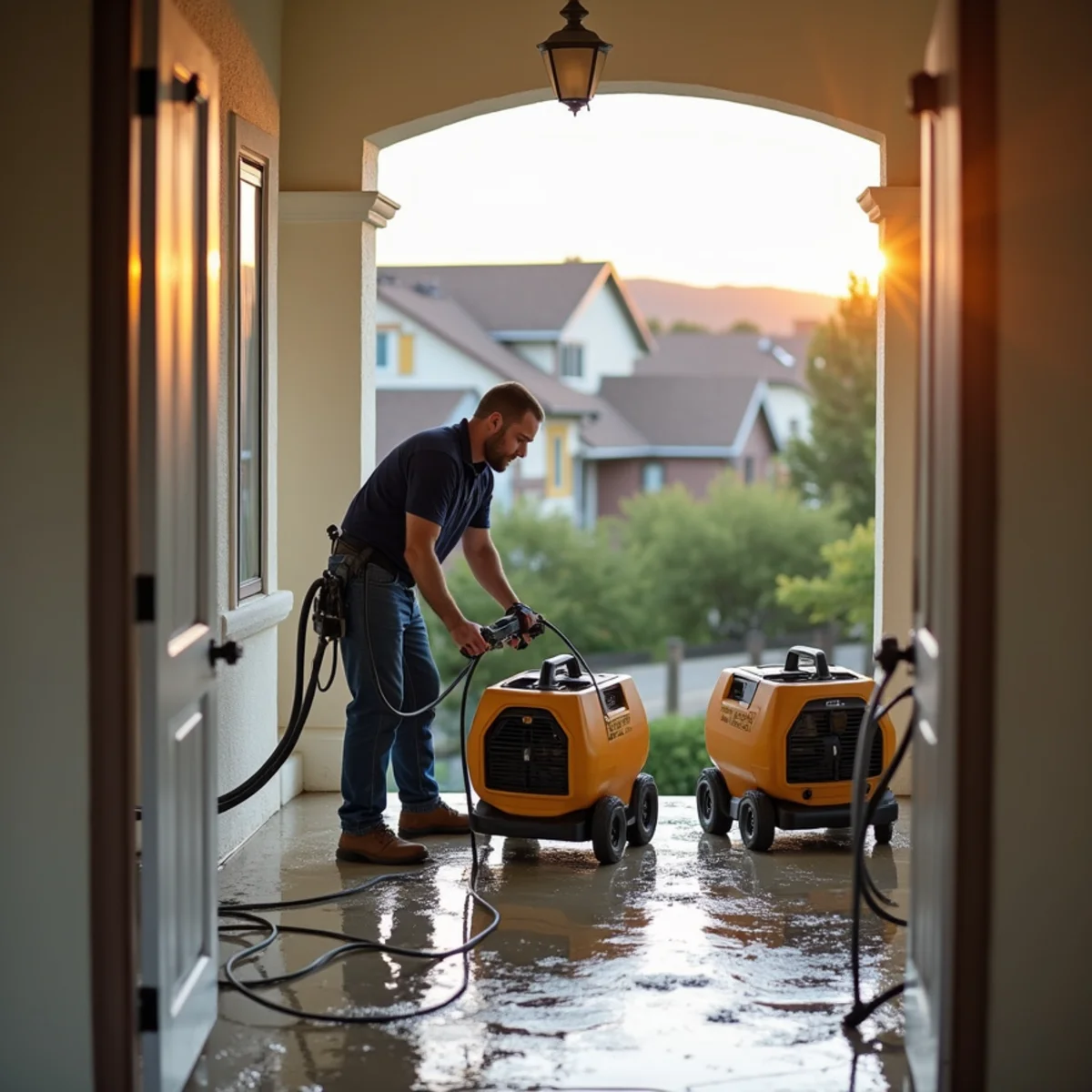
Crews staged on San Ramon Valley Blvd. 24/7 dispatch, 60-minute response across San Ramon.
- 24/7 emergency crews — nights, weekends and holidays
- 60-minute emergency response across San Ramon
- Free on-site estimate
- We bill your insurance directly
24/7 Emergency Service
Answered live, any hour
60-Minute Response
Across all of San Ramon
IICRC Certified
Works to the S500 standard
Insurance Billed Direct
Daily moisture logs
Water moves faster than most homeowners expect. A half-inch supply line under a kitchen sink pushes several gallons a minute, and in the time it takes to find the shutoff, that water has already run under the cabinet toe-kick, along the subfloor seams and into the wall cavity behind the dishwasher. What you can see on the floor is almost never the whole job. What you cannot see — the moisture wicking up drywall, sitting in insulation, and soaking the underside of engineered flooring — is what turns a two-day dry-out into a four-week rebuild.
San Ramon Water Damage Pros is a local restoration company working out of 2551 San Ramon Valley Blvd, which puts our trucks minutes from Central San Ramon, Dougherty Valley, Twin Creeks and the Bishop Ranch corridor. We answer the phone at 2 a.m. We follow the ANSI/IICRC S500 standard — the same document your insurance adjuster references — and we write down every moisture reading we take so that your claim is supported by data rather than by an argument.
This page walks through what actually happens on a water damage job in San Ramon: the categories of water and why they change everything, the equipment that does the real work, how long drying genuinely takes, what drives the cost up or down, and how the insurance side is handled. If you are standing in water right now, stop reading and call — the first hour matters more than anything else on this page.
Request help with water damage restoration
Tell us what happened. We respond within one business hour — or call now for a 24/7 emergency dispatch.
Know the signs
Signs You Have Water Damage That Needs a Professional
Standing water anywhere in the structure
Any depth, any room. Standing water is a clock, not a puddle. Drywall wicks moisture upward roughly an inch an hour, so a floor flood becomes a wall problem faster than most people believe.
A stain on the ceiling that keeps growing
A visible ceiling stain is the bottom edge of a much larger wet area above it. By the time drywall discolors, the insulation and framing overhead have usually been wet for a while.
Flooring that has cupped, buckled or gone soft underfoot
Hardwood cups when the underside is wetter than the top. Laminate swells at the seams. A soft spot in a tile floor usually means the subfloor beneath it has failed.
A musty smell with no visible source
That odor is microbial growth producing gas. If you can smell it, there is wet organic material somewhere — behind a wall, under a cabinet, or in a crawl space.
A warm spot on a slab floor or the sound of running water
Both are classic slab leak signs in San Ramon’s 1970s–80s tract housing. A hot-side slab leak warms the concrete above it and can run for weeks before it surfaces.
An EBMUD bill that jumped without a change in use
A sudden bill spike with no explanation is usually a leak running continuously somewhere you cannot see — irrigation, a slab line, or a toilet flapper feeding the drain.
Peeling paint, bubbling drywall tape or rusted nail heads
Finish materials fail before framing does. Bubbling tape at a seam and rust bleeding through paint both indicate the wall assembly behind them has been wet repeatedly.
Our process
Our Water Damage Restoration Process, Step by Step
 1
1Emergency call and dispatch
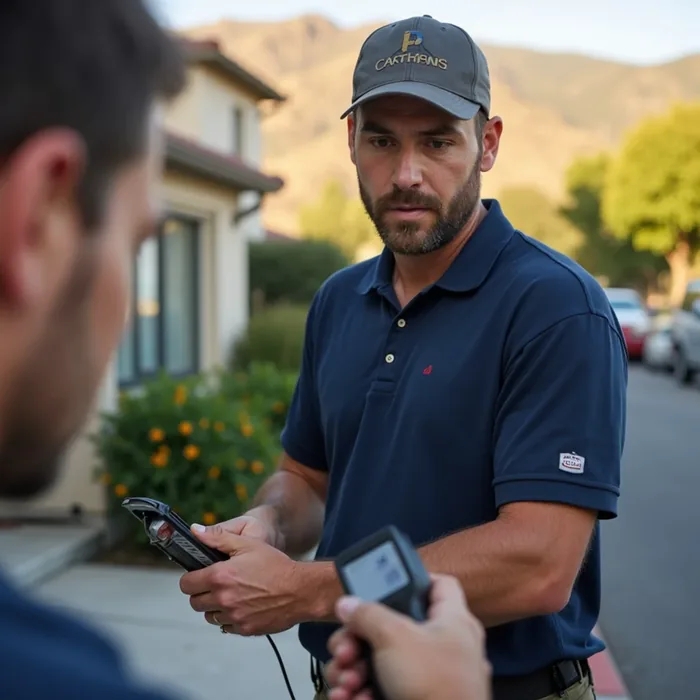
Immediate — crew on site within 60 minutes across San RamonYou reach a person, not a queue. We confirm your address, ask where the water is coming from and whether it is clean or contaminated, and talk you through shutting off the main valve and killing power to affected circuits while the truck is rolling.
 2
2Inspection, moisture mapping and category call
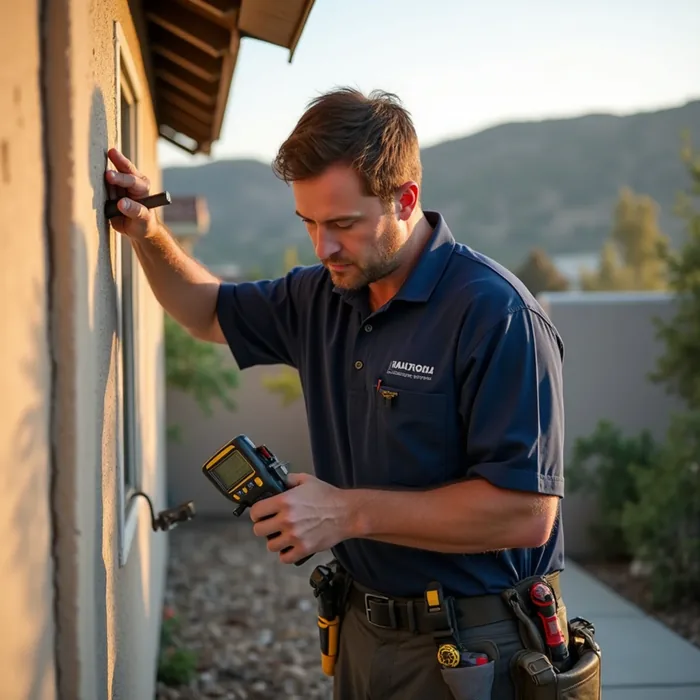
1–2 hoursWe walk the structure with thermal imaging and both pin and pinless moisture meters, marking the true wet perimeter — which is nearly always larger than the visible one. We classify the water as Category 1, 2 or 3 and the loss as Class 1 through 4, because those two calls determine everything that follows.
 3
3Water extraction
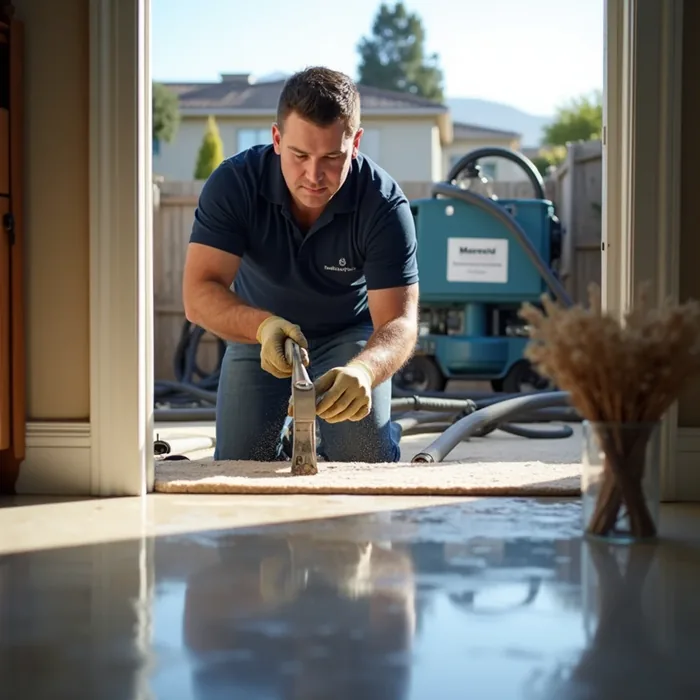
2–4 hours depending on volumeTruck-mounted and portable extraction units pull standing water, then weighted extraction tools compress carpet and pad to pull the water that hides in the cushion. Removing water mechanically is dramatically faster and cheaper than evaporating it later, so we extract aggressively before a single fan goes down.
- 4
Containment and controlled demolition
1–3 hours when requiredWhere material cannot be saved — saturated pad, swollen laminate, wet insulation, drywall below the wick line — it comes out under containment. We cut to a clean, straight line at a logical height so the rebuild is a simple patch rather than a whole-wall replacement.
- 5
Structural drying and dehumidification
3–5 days typical; longer for dense materials or severe lossesAir movers are placed to sweep the wet surfaces at the right angle and spacing, and commercial dehumidifiers pull the released vapor out of the air. We calculate the equipment load from the affected volume and class — not by eyeballing it — and we return daily to take readings and reset the plan.
- 6
Cleaning, sanitizing and deodorizing
1–2 days, usually overlapping with dryingAffected surfaces are cleaned and treated. For Category 2 and 3 losses we run HEPA air scrubbers throughout, apply an appropriate antimicrobial, and handle contents and soft goods separately from the structure.
- 7
Moisture verification against a dry standard
1 day, or as long as it takes to hit the standardWe do not call a job dry because it feels dry. We establish a dry standard from unaffected materials in the same building and keep equipment running until affected materials meet it. The final readings go into your drying log.
- 8
Repairs and reconstruction
Varies with scope — days to weeksDrywall, texture, paint, baseboard, flooring and cabinetry go back. Scope and timeline vary widely with what came out — we give you a written scope before this phase starts, not a running tab.
The whole timeline at a glance
The same eight phases, compressed for scanning. Durations are typical for a San Ramon single-family home — a large loss or a Category 3 job runs longer, and we tell you that on day one rather than on day six.
| Phase | What happens | Typical duration |
|---|---|---|
| 1. Emergency call and dispatch | You reach a person, not a queue. We confirm your address, ask where the water is coming from and whether it is clean or contaminated, and talk you through shutting off the main valve and killing power to affected circuits while the truck is rolling. | Immediate — crew on site within 60 minutes across San Ramon |
| 2. Inspection, moisture mapping and category call | We walk the structure with thermal imaging and both pin and pinless moisture meters, marking the true wet perimeter — which is nearly always larger than the visible one. We classify the water as Category 1, 2 or 3 and the loss as Class 1 through 4, because those two calls determine everything that follows. | 1–2 hours |
| 3. Water extraction | Truck-mounted and portable extraction units pull standing water, then weighted extraction tools compress carpet and pad to pull the water that hides in the cushion. Removing water mechanically is dramatically faster and cheaper than evaporating it later, so we extract aggressively before a single fan goes down. | 2–4 hours depending on volume |
| 4. Containment and controlled demolition | Where material cannot be saved — saturated pad, swollen laminate, wet insulation, drywall below the wick line — it comes out under containment. We cut to a clean, straight line at a logical height so the rebuild is a simple patch rather than a whole-wall replacement. | 1–3 hours when required |
| 5. Structural drying and dehumidification | Air movers are placed to sweep the wet surfaces at the right angle and spacing, and commercial dehumidifiers pull the released vapor out of the air. We calculate the equipment load from the affected volume and class — not by eyeballing it — and we return daily to take readings and reset the plan. | 3–5 days typical; longer for dense materials or severe losses |
| 6. Cleaning, sanitizing and deodorizing | Affected surfaces are cleaned and treated. For Category 2 and 3 losses we run HEPA air scrubbers throughout, apply an appropriate antimicrobial, and handle contents and soft goods separately from the structure. | 1–2 days, usually overlapping with drying |
| 7. Moisture verification against a dry standard | We do not call a job dry because it feels dry. We establish a dry standard from unaffected materials in the same building and keep equipment running until affected materials meet it. The final readings go into your drying log. | 1 day, or as long as it takes to hit the standard |
| 8. Repairs and reconstruction | Drywall, texture, paint, baseboard, flooring and cabinetry go back. Scope and timeline vary widely with what came out — we give you a written scope before this phase starts, not a running tab. | Varies with scope — days to weeks |
Every phase is documented as it happens. The moisture readings from phases 5 and 7 are what make up the drying log you hand your adjuster.
What you actually get
What a Full Restoration Includes
24/7 emergency dispatch and source control
A live answer at any hour, a crew on site within 60 minutes across San Ramon, and help shutting off the water on the phone before we arrive.
Documented category and class determination
The two S500 calls that drive every decision on your job, made on site and given to you in writing rather than kept in a technician's head.
Full moisture mapping of the affected area
Thermal imaging plus pin and pinless meters to find the real wet perimeter — inside wall cavities, under flooring, above ceilings — not just where you can see water.
Mechanical extraction before any drying
Truck-mounted and weighted extraction to remove water physically, which is faster and cheaper than evaporating it and is what usually saves your carpet pad.
Engineered drying with daily monitoring
Air movers and dehumidifiers sized to the affected volume and class, plus a technician back every day to log readings and reset the plan.
A dry standard you can check
Readings taken from unaffected materials in your own building set the target, and equipment stays until affected materials match it.
The complete drying log at handover
Daily moisture readings, the dry standard, equipment placement and photographs — the file your adjuster needs and your proof the structure was actually dried.
Reconstruction back to matching finish
Insulation, drywall, texture match, paint, trim, flooring and cabinetry, with a written scope agreed before that phase starts.
What is never included: a price quoted before we have seen the property, or equipment pulled before the dry standard is met. Both are how incomplete jobs happen.
Why San Ramon Water Damage Pros
Why San Ramon Calls Us for Full Restoration
One company from extraction to paint
Mitigation and reconstruction under one roof means the moisture documentation and the repair scope are produced by the same people. No gap where two contractors blame each other while your claim sits.
Base on San Ramon Valley Blvd
Minutes from Central San Ramon, Dougherty Valley and Bishop Ranch, on the I-680 corridor. That is what makes a 60-minute commitment realistic rather than a marketing line.
IICRC-certified, licensed and insured
Technicians working to ANSI/IICRC S500, a California CSLB licence you can verify yourself, general liability and workers' compensation cover, and background-checked crews.
We bill your insurance directly
The claim file is built from the first hour — photographs before anything moves, the failed component documented, daily logs — because under-documented mitigation is the most common reason claims get partially denied.
Need water damage restoration in San Ramon right now?
We answer live 24 hours a day and dispatch immediately. The first hour decides how much of your property we can save.
- Free on-site estimate
- We bill your insurance directly
- IICRC-certified technicians
Category 1, 2 and 3 Water — Why the Source Changes Everything
Before any equipment goes down, the water has to be classified. This is not paperwork. The category determines what can be saved, what has to be thrown away, what protective equipment the crew wears, and what the job costs. It is also the single thing homeowners most often get wrong on their own — clean-looking water is not the same as clean water.
Category also degrades with time. Category 1 water sitting in a warm, dark structure for 48 hours picks up bacteria from building materials and drops to Category 2. That is the mechanical reason why waiting to call is expensive: the delay does not just add drying time, it can change the classification of the entire loss and take salvageable materials off the table.
- Category 1 — clean water from a sanitary source: a supply line, a water heater inlet, a tub overflow. Carpet and pad are often salvageable if extraction starts quickly.
- Category 2 — "grey" water carrying meaningful contamination: dishwasher and washing machine discharge, toilet overflow without solids, aquarium water. Pad comes out; carpet may be cleanable.
- Category 3 — "black" water, grossly contaminated: sewage backups, any water from a sewer lateral, rising creek or storm water that has crossed the ground. Porous materials come out and are disposed of; the work is done under containment with full PPE.
- Any category left standing long enough will support microbial growth, which is why the 24–48 hour window matters more than the original source.
Class 1 to 4 — the Other Half of the Assessment
Category tells you what the water is. Class tells you how much of it the building absorbed and how hard the drying will be. Both are assigned on site under the ANSI/IICRC S500 standard, and both go in writing, because together they determine the equipment load, the number of drying chambers and the realistic timeline.
This is the part homeowners rarely hear explained, and it is why two losses with the same square footage can need very different amounts of equipment. A Class 1 loss in a tiled entryway and a Class 3 loss where water came down from a burst upstairs line are not comparable jobs even if the wet area measures the same.
- Class 1 — the least absorption. Minimal wet material, low evaporation load, often a hard-surface floor with little wicking. Fastest to dry.
- Class 2 — a whole room affected, with water wicked up the walls less than roughly two feet. Carpet, pad and the lower wall assembly are involved.
- Class 3 — water came from overhead, saturating ceilings, walls, insulation and flooring. The greatest evaporation load, and usually the most equipment.
- Class 4 — specialty drying. Materials with very low permeance that release moisture slowly: hardwood, plaster, concrete, stone. Needs longer schedules and often injection or floor-mat drying systems.
The Equipment That Does the Actual Work
Restoration is an equipment trade, and the gap between a job that holds up and one that produces a mould call six weeks later is mostly a question of whether the right machines were sized correctly and left running long enough. Here is what comes off the truck and what each thing is actually for.
Two of these deserve emphasis because they are what separate measurement from guessing. Thermal imaging finds the temperature differential where evaporation is happening behind a surface, which is how we map the true wet perimeter instead of the visible one. Pin and pinless moisture meters then quantify it — pinless for fast non-destructive scanning across an area, pin meters for a precise reading inside a specific material.
- Truck-mounted and portable extraction units, plus weighted extraction tools that compress carpet and pad to pull the water the surface pass leaves behind.
- Commercial LGR dehumidifiers, and desiccant units where the volume or the conditions call for them.
- Axial air movers, placed at a shallow angle and calculated spacing to break the boundary layer of saturated air clinging to wet surfaces.
- Thermal imaging cameras and both pin and pinless moisture meters, used daily to log readings against a dry standard.
- HEPA air scrubbers and negative air machines for Category 2 and 3 work, plus poly containment to isolate the drying chamber.
- Specialty floor drying mats and injection drying systems for hardwood and closed wall cavities — the Class 4 toolkit.
Prevention Tools Worth Owning Before You Need Us
We would rather you never called. These are the interventions that actually prevent the losses we respond to most, roughly in order of how much damage they avert per dollar.
The one that matters most for anyone who travels or has a water heater on an upper floor is the automatic shut-off valve. A leak sensor tells you there is water; a shut-off valve closes the supply. If the failure happens while you are at work, only the second one helps.
- Braided stainless washing machine hoses in place of rubber — about thirty dollars, and it removes one of the highest-volume failures in any house.
- A drip pan plumbed to an actual drain under the water heater, not a pan sitting there catching nothing.
- Smart leak sensors at the water heater pan, behind the washing machine, under the kitchen sink and at each vanity.
- A whole-home automatic shut-off valve — sensor-triggered, or flow-monitoring, which also catches in-wall pinhole and under-slab leaks a floor sensor never would.
- A sump pump with battery backup for crawl spaces and lower levels, because peak storm flow and power outages arrive together.
- A photo-inventory app that timestamps and geotags images — an organised, verifiable record that adjusters accept far more readily than scattered phone photos.
How to Tell a Real Restoration Company From a Storm Chaser
After every major Tri-Valley storm, companies appear that were not here the week before and will not be here the month after. Some are competent operations working a wide territory. Some are not. Because you are choosing a contractor under stress, usually in the first hour of an emergency, it is worth knowing what to ask before you sign anything.
These are the questions we would ask if we were in your position — and yes, you should ask them of us too. A company that cannot answer them quickly and specifically is telling you something.
- Are your technicians IICRC-certified, and do you work to the ANSI/IICRC S500 standard? Ask for the certification, not just the claim.
- What is your California CSLB licence number? The Contractors State License Board runs a free public lookup — verify it yourself, for us or anyone else.
- Do you carry general liability and workers’ compensation, and are your crews background-checked before they enter my home?
- Will you determine the water category and damage class on site and give me that in writing?
- Will I get daily moisture readings and a final drying log showing the structure met a dry standard? If a company cannot produce one, there is no evidence the job was ever finished.
- Will you give me a written scope and estimate before reconstruction starts, rather than an open-ended tab?
- Do not sign a broad "work authorisation" or an assignment of benefits without reading exactly what you are assigning. Legitimate companies will give you time to read it.
What Causes Water Damage in San Ramon Homes
The failure patterns here are specific, and they cluster by neighborhood and build era. Central San Ramon, Broadmoor and Old Ranch are dominated by 1970s and early-80s slab-on-grade tract housing — original supply lines, first-generation sewer laterals, and water heaters that have been replaced once if at all. Dougherty Valley, Windemere and Gale Ranch are a completely different problem: 2000s master-planned homes where builder-grade angle stops, braided connectors and appliance valves are all hitting their first failure window at roughly the same time.
Two things cut across every neighborhood. First, EBMUD water in the Tri-Valley runs 16 to 18 grains per gallon — "very hard" by any measure — which drives scale in water heaters and pitting corrosion in copper supply lines, the mechanism behind the pinhole leaks we see constantly in 1980s and 90s homes. Second, the San Ramon Valley sits on expansive clay soil that swells through the wet season and shrinks through the dry one, cycling stress into slabs and the pipes running under them.
- Burst and pinhole supply lines — the fastest-moving and most destructive category by volume.
- Water heater failures — 40 to 75 gallons released at once, and in many Dougherty Valley and Gale Ranch homes the tank sits on an upper-floor platform, so the water travels down through ceilings.
- Appliance and supply line leaks — dishwashers, ice makers, washing machines and under-sink lines, usually slow and hidden until flooring or cabinetry fails.
- Slab leaks — hot- or cold-side lines failing under the concrete, accelerated by hard water and clay soil movement.
- Sewage backups — tree roots in older laterals, blockages, and stormwater loading the sanitary system during heavy rain.
- Storm and creek intrusion — atmospheric river events overwhelming gutters, drains and grading, plus roof and flashing failures after Diablo wind season.
Creek and Storm Flooding: What the Numbers Actually Say
San Ramon does not read as a flood city, and statistically it is not. But "low risk citywide" and "low risk on your particular lot" are very different statements, and the difference matters enormously if you happen to be in the second group.
First Street Foundation data indicates roughly 964 San Ramon properties — about 3.7% of the city — carry at least minor flood risk over a 30-year horizon. That is a small share of the city and a very large number of households, and it is not evenly distributed. San Ramon Creek and Bollinger Creek run through the city alongside an engineered network of storm drains and detention basins maintained by Contra Costa County Flood Control, and the properties that take water are concentrated along those corridors and on hillside runoff paths.
We cover both San Ramon ZIP codes — 94583 across the central and western neighborhoods, and 94582 through Dougherty Valley, Windemere, Gale Ranch and the eastern canyon edge. In practice, most of the storm intrusion we respond to across both is a private drainage failure rather than a creek event: a gutter that stopped working in November, an area drain silted closed over the dry season, or grading that settled and now runs toward the house.
- Highest exposure: properties adjacent to the San Ramon Creek and Bollinger Creek corridors, and low-lying sections of Norris Canyon and Crow Canyon.
- Hillside lots where saturated slope above the house sheds runoff toward the foundation — Bollinger Hills, Sycamore Heights, Round Hill.
- Homes downhill of open space, where post-fire runoff carries sediment that buries area drains mid-storm.
- Any water that crossed the ground is Category 3 by definition, regardless of how clear it looks — it is handled with containment, PPE and disposal of porous materials.
- Critically: standard homeowners policies exclude all of this. Flood coverage is separate, and it carries a waiting period — see the insurance section below.
Insurance Claims: What Is Covered, and How We Handle the Paperwork
The distinction that decides most San Ramon claims is simple to state and easy to get wrong: sudden and accidental water originating inside the home is generally covered by a standard homeowners policy. Water that rises from outside and enters the structure generally is not — that is flood, and it requires separate coverage through the NFIP or a private carrier.
So a burst supply line, a failed water heater or a dishwasher hose letting go is typically a covered loss. San Ramon Creek or Bollinger Creek coming over its banks, surface water sheeting off a saturated hillside, or groundwater pushing up through a slab typically is not. Sewage backup sits in between and usually depends on whether a specific backup endorsement was added to the policy — worth checking before you need it.
We bill insurance directly and we build the file the way adjusters want it: photographs before anything is moved, a documented category and class call, a written scope, and a daily drying log with moisture readings that demonstrates the structure was dried to a defensible standard. Under-documented mitigation is the most common reason a claim gets partially denied, and it is entirely avoidable.
- Report the claim to your carrier as soon as you can — but do not wait for an adjuster to authorize emergency mitigation. Most policies obligate you to prevent further damage, so waiting can itself work against the claim.
- Photograph and video everything before moving a single item, including water lines on walls and the failed component itself.
- Keep every receipt: emergency supplies, temporary housing, meals if you are displaced. Most policies include Additional Living Expense coverage and it is routinely underclaimed.
- Do not dispose of damaged contents until they have been documented and, where required, seen by the adjuster.
- Ask for a copy of the drying log at completion. It is your proof the structure met a dry standard.
The Two Coverage Gaps Almost Nobody Checks Until It Is Too Late
Two endorsements decide whether a large share of San Ramon losses are covered at all, and both are cheap relative to the exposure. Neither is included by default.
The first is flood. NFIP policies — and most private flood policies — carry a 30-day waiting period before coverage takes effect. That means flood insurance cannot be bought reactively: when the National Weather Service starts forecasting an atmospheric river sequence in December, it is already too late. If you are near a creek corridor, on a hillside runoff path or downhill of open space, it needs to be in place by early autumn. NFIP also covers building and contents separately, and you have to buy both.
The second is sewer and drain backup, which is excluded from essentially every standard California homeowners policy. Where the endorsement exists, its limit is frequently capped well below the dwelling limit — often in the five-to-twenty-five-thousand range. A Category 3 loss across a finished lower level with cabinetry and flooring can exceed that comfortably. In the older San Ramon neighborhoods where mature roots meet original clay-tile laterals — Broadmoor, Crow Canyon, Montevideo, the Iron Horse corridor — this is not a hypothetical risk.
Both are worth a five-minute call to your agent today rather than a discovery on the worst day of your year.
Why San Ramon Homeowners Call Us
There are two kinds of companies that show up after a loss in the Tri-Valley: national franchises running a call center and a script, and local crews who know which streets flood and which subdivisions put the water heater upstairs. We are the second kind, and it shows up in practical ways — a truck that is already close, a technician who has seen your floor plan before, and an honest answer about whether your hardwood is coming back.
- Local dispatch from San Ramon Valley Blvd with a 60-minute response commitment across the city.
- IICRC-certified technicians working to the ANSI/IICRC S500 standard, not to a franchise checklist.
- Licensed and insured in California with a CSLB licence you can verify yourself, general liability and workers’ compensation cover, and background-checked crews.
- Contaminated work follows published OSHA and CDC guidance on sewage handling and PPE, and EPA guidance on mould remediation — not house rules.
- Written scope and estimate before reconstruction begins — no open-ended tabs.
- Direct insurance billing, with documentation built for the adjuster from the first hour.
- Daily moisture readings you can actually see, and a dry standard we have to hit before we pull equipment.
- One company from extraction through rebuild, so nobody gets to blame the other trade.
Honest pricing
What Water Damage Restoration Costs in San Ramon — and What Drives It
Water category
The single biggest driver. Category 3 work requires containment, PPE, HEPA filtration and disposal of porous materials — it is a fundamentally different job from a clean-water loss of the same size.
Affected square footage and the number of rooms
Not just floor area — the wet perimeter inside walls and the number of separate drying chambers we have to establish and monitor.
How long the water sat
Time is the variable you control. Same leak, called in at hour one versus day three, is often the difference between drying materials in place and demolishing them.
Materials involved
Carpet and pad dry easily. Engineered hardwood, dense hardwood, plaster, and multi-layer subfloor assemblies hold moisture stubbornly and take longer, which means more equipment days.
Equipment days
Drying is billed largely by how many air movers and dehumidifiers run for how many days. A tight, well-contained chamber dries faster and cheaper than an open, uncontained one.
Accessibility
Crawl spaces, upper-floor losses that traveled down through ceilings, and finished basements all take longer to reach and to dry than an open ground-floor room.
Reconstruction scope
Mitigation and rebuild are separate line items. Custom cabinetry, stone, and matched hardwood in a Blackhawk or Norris Canyon home carry very different rebuild costs than builder-grade finishes.
Worth knowing: Do not choose on price alone. The most expensive water loss is the one that was dried incompletely the first time, because mold remediation and a second demolition cost far more than the extra equipment days would have.
Where we provide this service
Water Damage Restoration across San Ramon and the Tri-Valley
FAQ
Water Damage Restoration questions we get asked
Mitigation work — extraction, drying and the demolition needed to get there, before any reconstruction — generally runs in the region of $3.50 to $7 per affected square foot in this market. Clean Category 1 losses sit at the low end; contaminated Category 3 work sits well above it, because containment, PPE and disposal of porous materials make it a fundamentally different job. Nobody can quote a water loss accurately over the phone, because the wet area inside your walls is almost always larger than what is visible. Your written estimate comes after a free on-site inspection.
Shut off the main water valve — in most San Ramon homes it is in the garage near the water heater, on an exterior wall where the service line enters, or in a covered box near the street. Cut power to the affected circuits only if you can reach the panel from a dry position. Photograph and video everything before you move anything, including the failed pipe or fitting itself, because that is the shot adjusters ask for and the first thing that gets thrown away. Then stay out of the wet area, and do not run household fans or a shop vacuum — you spread moisture and, on contaminated water, aerosolize it.
We dispatch 24/7 and commit to a 60-minute response anywhere in San Ramon, including Dougherty Valley, Windemere, Gale Ranch and the Bishop Ranch area. Our base at 2551 San Ramon Valley Blvd sits right on the I-680 corridor, which is what makes that commitment realistic rather than a marketing number. Danville, Alamo and Dublin are typically 10 to 20 minutes.
Structural drying typically takes three to five days, though dense materials, Category 3 losses and large-volume floods run longer. The job is finished when affected materials meet a dry standard measured against unaffected materials in the same building — not when surfaces feel dry to the touch. We take readings daily and show you the numbers.
Sudden and accidental water damage — a burst pipe, a failed water heater, an appliance supply line — is usually covered by a standard California homeowners policy. Rising creek or storm water is not; that requires separate flood insurance. Sewage backup is typically covered only with a specific endorsement. We bill carriers directly and document the loss so the claim holds up.
Often yes, for a contained Category 1 loss in one part of the house. For a Category 3 sewage event, or when drying equipment has to run in bedrooms and living areas, temporary relocation is usually the better call. We will give you a straight recommendation based on the affected areas and air quality, and your policy may cover additional living expenses.
Microbial growth can begin within 24 to 48 hours in warm, damp conditions, which is why immediate extraction matters far more than most homeowners realize. Getting materials genuinely dry inside that window is the whole point of professional drying — and it is why we verify against a dry standard instead of guessing.
Both. We take a loss from emergency extraction through structural drying and on into reconstruction — drywall, texture, paint, trim and flooring. Keeping mitigation and rebuild under one roof means the moisture documentation and the repair scope line up, and there is no gap where two contractors blame each other.
You might also need
Related services
24/7 Emergency Water Removal
A real person answers at 3 a.m., a truck rolls immediately, and we talk you through the shutoff while it does.
Learn moreWater Extraction & Removal
Truck-mounted and portable extraction that pulls water out mechanically — the fastest, cheapest way to stop a loss from spreading.
Learn moreMold Remediation
Containment-first remediation that removes growth and fixes the moisture source — because mold that comes back was never really removed.
Learn moreGet water damage restoration handled properly
Free on-site estimate, written scope before any reconstruction, and direct insurance billing with documentation your adjuster can actually use.
- Free on-site estimate
- We bill your insurance directly
- IICRC-certified technicians