San Ramon Gets ~20 Inches of Rain — Almost All of It November to March. Is Your Home Ready?
The annual total is unremarkable. The delivery schedule is the problem — most of it arrives in a handful of storms, at intensities that find every weakness at once.
Written by the San Ramon Water Damage Pros crew — IICRC-certified technicians working to the ANSI/IICRC S500 standard on water losses across San Ramon and the Tri-Valley. Guidance here reflects how we actually run jobs, not general advice.

San Ramon averages roughly 20 inches of rain a year, which sounds modest. Taken as an annual figure it is. What matters is the delivery: essentially all of it falls between November and March, and a large share of that arrives in a handful of atmospheric river events that drop weeks of rainfall over a day or two.
That concentration is the whole story. A drainage system that handles ordinary rain perfectly well can be overwhelmed by a single event, and because there is no rain for seven months, nobody notices the system stopped working until the exact moment it matters.
Water damage happening right now?
We answer live 24 hours a day and commit to a 60-minute response across San Ramon.
+1 (201) 277-9344Why Intensity Matters More Than Total
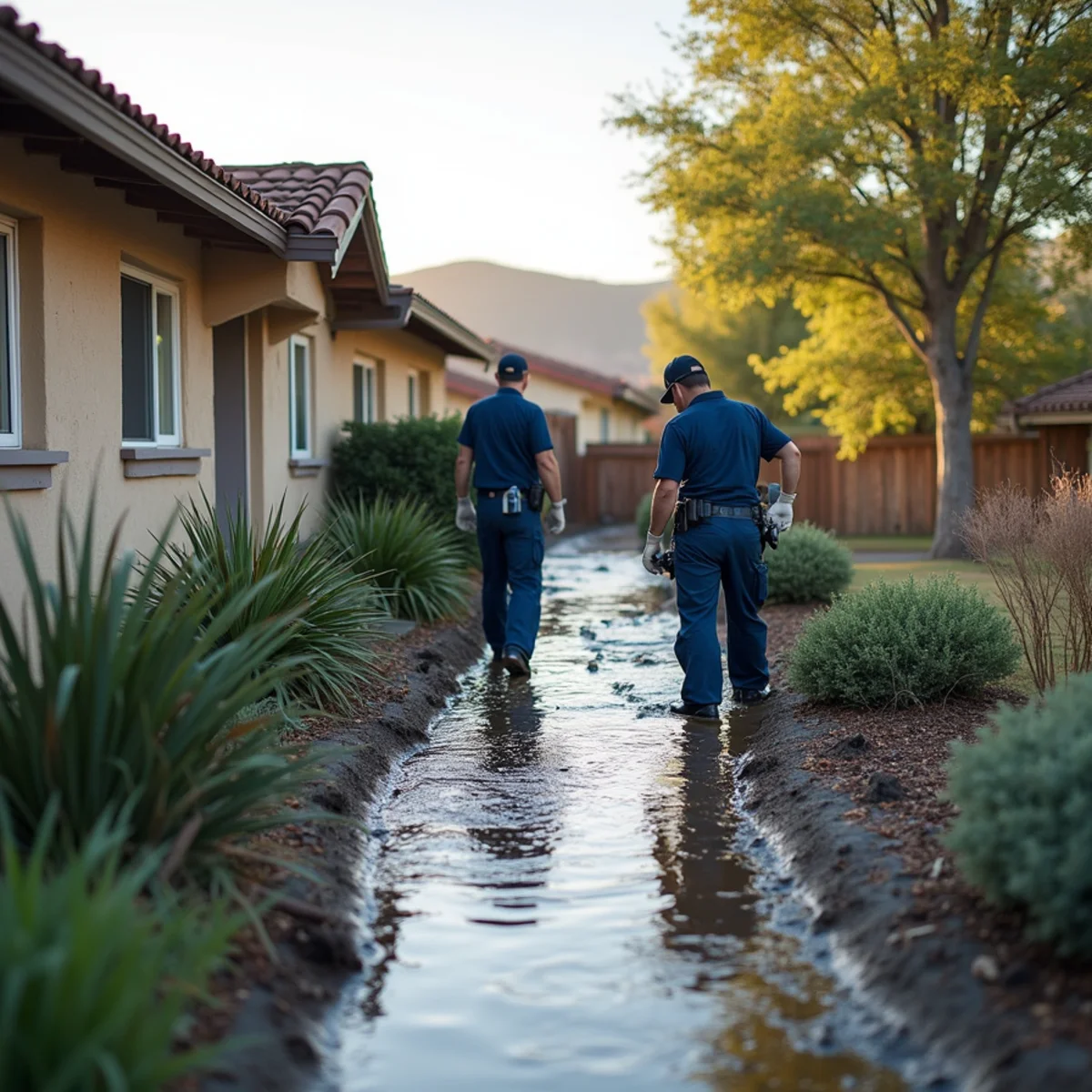
Gutters, downspouts, area drains and grading are all sized — implicitly or explicitly — for a certain rate of flow. Ordinary steady rain moves through the system with margin to spare. An atmospheric river delivers water faster than the system can carry it, and once capacity is exceeded, water goes wherever gravity takes it.
The second factor is soil saturation. During the first storm of the season, dry ground absorbs a great deal. By the third storm, the ground is saturated and essentially everything that falls becomes runoff. This is why the damaging events are usually not the first storm of the year but a later one in a sequence.
The third is duration. Sustained rain over 48 hours puts continuous hydrostatic pressure against foundations and below-grade walls in a way a short downpour does not.
The October Checklist
- Clear gutters completely, including the corners and the downspout inlets. Oak and sycamore litter fills them faster than people expect.
- Extend downspout discharge several feet from the foundation. Discharging at the base of a wall is the most common self-inflicted drainage problem there is.
- Flush every area and yard drain, and check that the outlet is clear. Sediment accumulates invisibly over the dry season.
- Walk the perimeter and look at grading. Ground should slope away from the house. Settlement over twenty years frequently reverses that.
- Check crawl space vents and access points for water paths.
- Inspect the roof — after the first wind event of the season, not before. Look for lifted or missing shingles, displaced ridge cap and flashing that has pulled away.
- Test the sump pump if you have one, and fit a battery backup if it does not have one.
- Check window and door weatherstripping and thresholds on the weather-exposed elevation.
- Clear debris from window wells and light wells.
Mid-Season Maintenance People Skip
Doing the October checklist and considering the job done is a mistake, because the wind that accompanies these storms keeps depositing material.
Re-clear gutters in December or January, particularly after a wind event. A gutter that was clean in October can be full by January in a neighborhood with heavy canopy — Montevideo, Crow Canyon, Lafayette, and most of Danville.
Check area drains again mid-season for the same reason. Sediment washed down during the first storms is exactly what clogs them for the second.
And walk the perimeter during a storm, not after. Watching where water actually goes while it is raining tells you more in five minutes than any dry-day inspection.
What We Respond To Every Season
- Water at garage slabs and low door thresholds — the most common entry point citywide.
- Crawl spaces taking runoff from saturated soil, discovered weeks later by smell.
- Roof leaks from wind damage that occurred in the previous months.
- Gutter overflow driving water down walls and into window flashing.
- Below-grade and lower-level rooms on hillside lots taking lateral groundwater.
- Sump pump failures during storm-driven power outages.
- Blocked sewer laterals surcharging as stormwater loads the sanitary system.
When the Storm Is Already Here
- If water is entering, prioritize diverting it at the source rather than mopping inside. Sandbags, temporary berms and redirected downspouts do more than towels.
- Photograph everything as it happens, including the entry path. On a storm claim, how water got in determines whether it is covered.
- Move contents up and out of the affected area.
- For active roof intrusion, call for emergency tarping — we tarp in the rain, because waiting means hours more water inside.
- Treat any water that crossed the ground as contaminated. It is Category 3 regardless of how clear it looks.
What an Atmospheric River Actually Does to a House
Most of the year's water arrives in a handful of multi-day events, and it is worth understanding what those do differently from ordinary rain. It is not simply more water — it is water arriving faster than the ground and the drainage can move it, for longer than either was designed to sustain.
- Soil reaches saturation within the first day, after which everything that falls becomes surface runoff rather than being absorbed.
- Gutters sized for typical rainfall overflow at the fascia, putting water directly against the wall and into the soffit rather than into the downspout.
- Area drains that cope with ordinary rain surcharge, and once a drainage system is full it backs up rather than accepting more.
- Hydrostatic pressure against below-grade walls builds over days, which is why seepage appears on day two or three rather than in the first hours.
- Wind arrives with the rain, so envelope details that shed vertical water take horizontal water at pressure at the same time.
- Multi-day duration removes the drying interval that normally lets a marginal detail recover between storms.
- Power interruptions coincide with peak demand on sump pumps, which is why a pump without a battery backup fails at precisely the wrong hour.
Frequently asked questions
Nearly all of the roughly 20 annual inches falls between November and March, with the most damaging events typically arriving mid-season when the ground is already saturated. The first storm of the year is rarely the problem; the third one in a sequence often is.
Clear the gutters and extend the downspouts away from the foundation. It costs nothing but time and it prevents more storm intrusion than anything else on the list. Second is flushing the area drains, because sediment disables them silently over the dry season.
It depends on how it entered. Through a storm-created opening like wind-damaged roofing — usually covered. Across the ground at a threshold or through a foundation — that is flood, and it is excluded from standard policies. Photograph the entry path before cleanup starts.
Yes, and it is mostly about interception. Clear the gutter outlets and area drains you can safely reach — much of what fails mid-storm is a drain choked by debris that arrived with the first hour of rain. Move anything of value off garage and lower-level floors, and know where your main shutoff is. Beyond that, do not get onto a roof or into standing water, and let the drainage work be done afterwards.
Usually direction and duration rather than volume. Wind-driven rain from one particular quarter finds envelope details that shed water perfectly well when rain falls vertically, so a leak that appears only in southerly storms points at a specific elevation. Multi-day events add the other variable — some assemblies cope with six hours of rain and not with forty-eight.
The short version
Twenty inches is nothing. Twenty inches delivered in six storms onto saturated ground is what puts water into houses.
Do the October checklist, redo the gutters in January, and call us if water does get in — we run storm response across San Ramon 24 hours a day.