Tree Roots in Your Sewer Line: Warning Signs to Catch Before the Backup
Root intrusion gives weeks of warning before it becomes a Category 3 cleanup. Almost nobody acts on it, because the signs seem too minor.
Written by the San Ramon Water Damage Pros crew — IICRC-certified technicians working to the ANSI/IICRC S500 standard on water losses across San Ramon and the Tri-Valley. Guidance here reflects how we actually run jobs, not general advice.
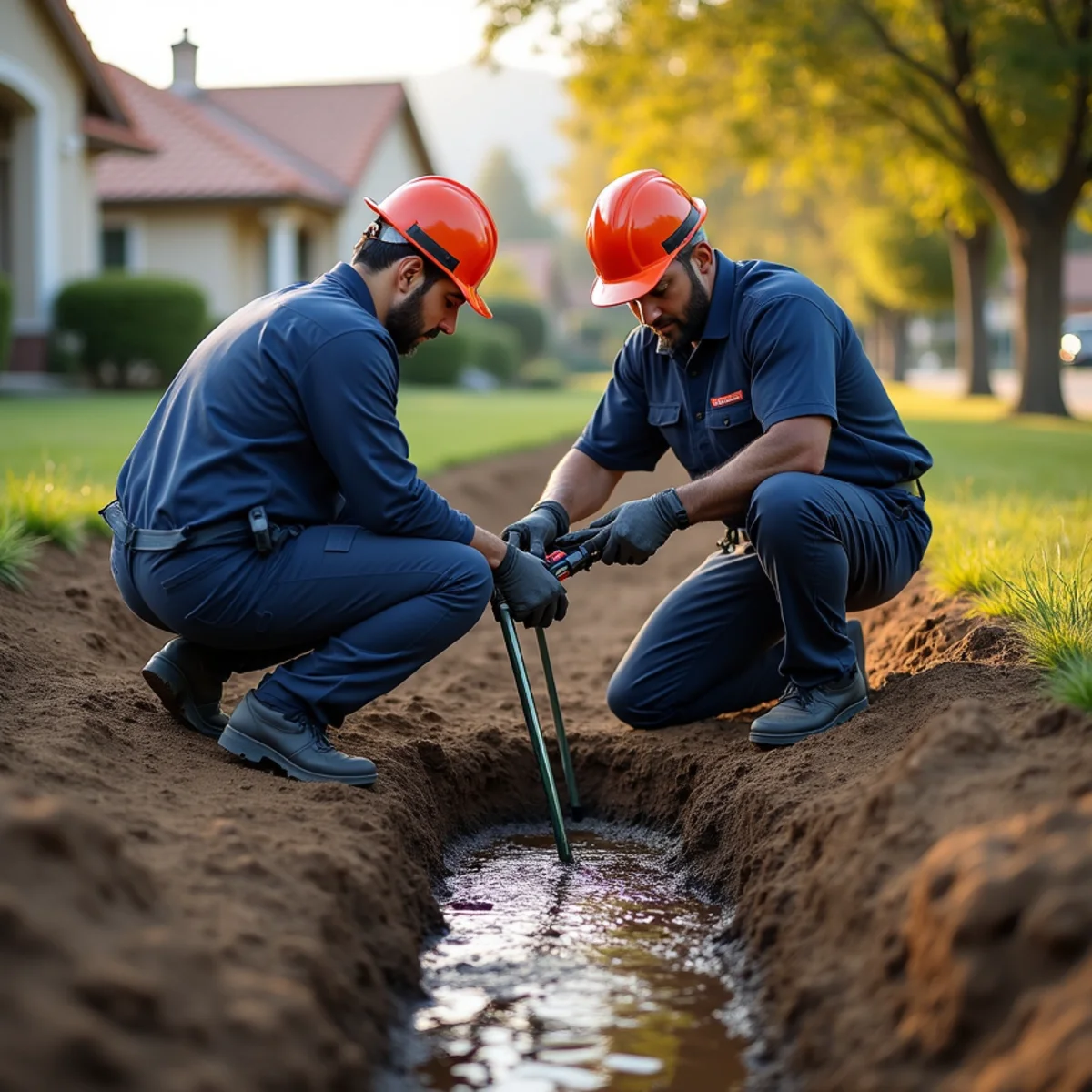
A root-blocked sewer lateral is one of the few household failures that reliably announces itself well in advance. The signals — a toilet that gurgles, several drains slowing at once, a patch of lawn greener than the rest — are subtle enough that people dismiss them, and expensive enough to ignore that they are worth taking seriously.
Every one of the sewage cleanups we do in San Ramon’s older neighborhoods was preceded by at least one of the signs below, usually for weeks.
Water damage happening right now?
We answer live 24 hours a day and commit to a 60-minute response across San Ramon.
+1 (201) 277-9344The Warning Signs, Roughly in Order of Appearance
- A toilet gurgling when you run a sink or the washing machine. This is air displacing past a partial blockage and it is the earliest reliable sign there is.
- Two or more drains slowing at the same time — especially a toilet and a tub together. One slow drain is a fixture problem; several is the main line.
- Water backing up in a lower fixture when an upper one drains.
- A sewer odour indoors, or noticeably around the exterior cleanout.
- Drains that improve after being snaked and then deteriorate again within months — roots regrow.
- An unusually lush, fast-growing or persistently soggy patch of lawn along the line from the house to the street.
- Sinkholes or soft depressions over the lateral run, which suggest the pipe has cracked or collapsed and soil is washing in.
Why This Is a San Ramon Problem Specifically
Two things have to coincide: pipe with joints that weep, and mature trees near it. Original clay-tile sewer laterals were laid in short sections with a joint every few feet, and those joints release small amounts of moisture and nutrients into the surrounding soil.
In a climate with dry summers, that is a reliable water source, and valley oaks in particular are efficient at finding it. Once a root hair enters a joint it thickens inside the pipe, forms a fibrous mass, and catches everything passing through.
The neighborhoods where the trees and the pipes are the same age produce most of this work: Broadmoor, Crow Canyon, Montevideo, the Iron Horse corridor, and the equivalent 1970s streets in Danville and Alamo where the canopy is even heavier.
How It Gets Diagnosed
A camera inspection is the definitive answer and it is inexpensive relative to what it prevents. A plumber runs a camera down the lateral from the cleanout and you see exactly what is in the pipe, where it is, how far from the house, and what condition the pipe itself is in.
That last part matters as much as the roots. The inspection distinguishes between a sound pipe with root intrusion at one joint — which can be cleared and managed — and a pipe that has cracked, offset or partially collapsed, which is a replacement conversation.
If your home is 1970s or older and the lateral has never been inspected, it is worth doing regardless of symptoms. Ask for a copy of the footage.
The Repair Options
Clearing — snaking or hydro-jetting
- A cutting head or high-pressure water removes the root mass and restores flow.
- Cheapest option, effective immediately, and entirely temporary — roots regrow through the same joint.
- Reasonable as ongoing maintenance on a sound pipe, typically on a one-to-two-year cycle.
Root treatment
- A foaming herbicide applied into the line kills roots inside the pipe and slows regrowth.
- Extends the interval between clearings; does not repair the joint they enter through.
Relining (cured-in-place pipe)
- A resin-saturated liner is inserted and cured, forming a continuous jointless pipe inside the old one.
- No trenching, so landscaping and driveways survive. Removes every joint roots could enter.
- Requires the existing pipe to be structurally sound enough to host the liner.
Replacement
- Excavating and replacing the lateral, or pipe bursting to pull new pipe through the old path.
- Most disruptive and most expensive; the right answer for a collapsed or badly offset line.
- Modern materials have no joints for roots to exploit.
What About Insurance?
The lateral itself is generally your responsibility, not the utility’s, and repairing it is normally excluded from a homeowners policy as a maintenance item. Some carriers offer service line coverage as an endorsement, which covers the buried water and sewer lines from the street to the house — worth asking about, particularly on large lots with long runs.
The resulting sewage damage inside the house is a separate question, and it depends on whether you carry the water or sewer backup endorsement. Base policies exclude it.
Keeping the Line Clear Once It Has Been Cleared
Clearing roots is not a permanent fix on its own, because the conditions that attracted them have not changed. What you do afterwards determines whether you are back in the same position in two years or in twenty.
- Get a camera inspection immediately after clearing, while the line is clean. That is when you can actually see the pipe condition rather than the blockage.
- Establish the interval that suits your line. Some properties need clearing every two years, some every five, and the camera footage is what tells you which.
- Consider lining if the host pipe still holds its shape. A cured-in-place liner seals the joints roots use and generally makes recurrence a non-issue.
- Replace rather than line where the pipe has collapsed, sagged badly or lost sections. Lining a failed pipe just produces a lined failed pipe.
- Fix any surface issue that is feeding the roots. A leaking irrigation line above the lateral gives roots a reason to be in that area at all.
- Be realistic about the tree. Removing a mature oak to protect a sewer line is rarely the right trade in this valley, and the line can be engineered around it.
- Keep the footage. A recorded baseline makes the next inspection far more useful, because you are comparing rather than guessing.
Frequently asked questions
A toilet gurgling when you run a sink or the washing machine. That is air being displaced past a partial blockage, and it typically appears weeks before anything backs up. If you hear it, get a camera inspection.
Usually not. Relining the lateral removes the joints roots enter through, which solves the problem without touching the tree. Given what a mature valley oak contributes to a property, fixing the pipe is nearly always the better trade.
Typically within one to two years, because clearing removes the mass but leaves the joint they entered through. That is why clearing is maintenance rather than repair — and why relining pencils out once you are on your second or third clearing.
Usually, in competent hands and at an appropriate pressure — it is the standard method for clearing root mass and it does not harm a structurally sound clay pipe. Where it is not appropriate is on a line that is already cracked, offset or partially collapsed, because the pressure can worsen a failing section. That is exactly why the camera inspection comes first rather than afterwards.
They have a narrow role. Foaming root killers applied through a cleanout can slow regrowth after mechanical clearing, and they are gentler on the line than they are on the tree. What they do not do is clear an existing blockage or repair the joints letting roots in. Treating them as maintenance between inspections is reasonable; treating them as the solution is not.
The short version
Gurgling toilets and multiple slow drains are the warning. A camera inspection is cheap. A Category 3 cleanup across a finished floor is not.
We handle the sewage side when a line does back up, and we will tell you honestly whether what we are seeing is a clearing problem or a lateral replacement problem.