How to Find and Shut Off Your Home's Main Water Valve (Before You Ever Need To)
The five minutes you spend finding this valve today is the highest-return home maintenance task there is. Do it before the emergency, not during one.
Written by the San Ramon Water Damage Pros crew — IICRC-certified technicians working to the ANSI/IICRC S500 standard on water losses across San Ramon and the Tri-Valley. Guidance here reflects how we actually run jobs, not general advice.
Nearly every serious water loss we respond to includes the same sentence somewhere in the first phone call: "I don’t know where the shutoff is." The homeowner then spends five, ten, sometimes twenty minutes searching while several gallons a minute pour into the house.
Finding it takes five minutes on a calm afternoon. Doing it now is genuinely the highest-return maintenance task available to you, and it costs nothing.
Water damage happening right now?
We answer live 24 hours a day and commit to a 60-minute response across San Ramon.
+1 (201) 277-9344The Three Places It Usually Is
In San Ramon homes the main shutoff is almost always in one of three locations, and which one depends largely on the era and foundation type of the house.
1. In the garage, near the water heater
- Most common in slab-on-grade homes, which covers a large share of the city.
- Look on the wall where the water line comes up out of the slab, usually within a few feet of the heater.
- Often a lever-style ball valve, sometimes a round gate valve handle.
2. On an exterior wall where the service line enters
- Frequently on the street-facing side or in a side yard.
- Sometimes behind an access panel or inside a small utility box.
- Look for a copper or galvanized pipe emerging from the ground and turning into the wall.
3. In a covered box near the street
- A rectangular concrete or plastic lid set flush in the ground, near the sidewalk or property line.
- This is the meter box. It contains the EBMUD meter and usually a customer-side valve.
- Opening it may need a screwdriver or a meter key to lift the lid.
How to Turn It Off
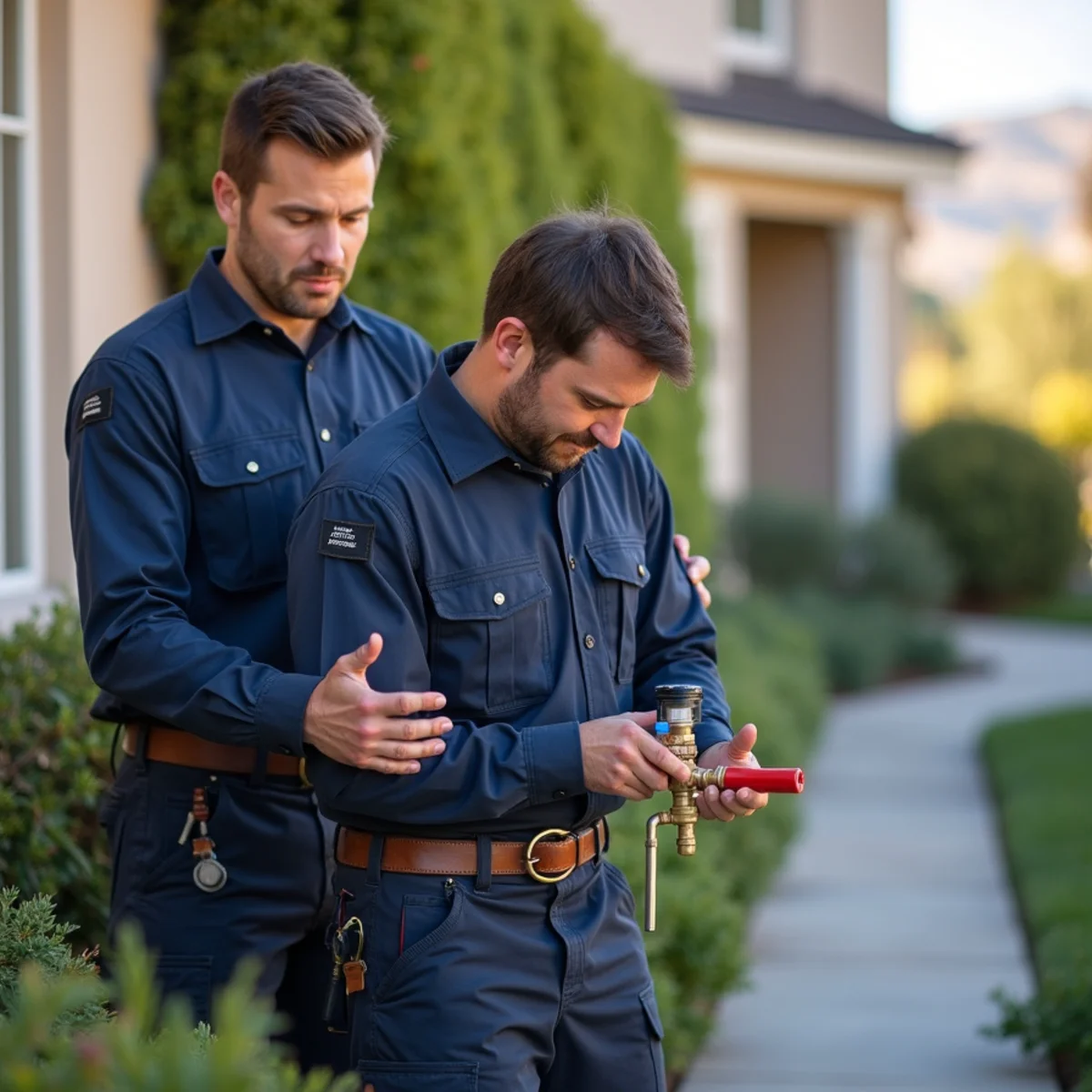
There are two valve types and they close differently. A ball valve has a lever handle: turn it a quarter turn so the lever sits perpendicular — across — the pipe. When the lever is parallel with the pipe, the valve is open. A gate valve has a round wheel handle: turn it clockwise, and keep turning, because it may take several full rotations to close completely.
Once it is closed, verify. Open a faucet somewhere in the house — the flow should drop to a trickle and stop within a few seconds. If water keeps running steadily, either the valve did not fully close or you closed the wrong one.
Do This Now: Exercise the Valve
This is the part people skip and it matters more than knowing the location. A valve that has not been operated in twenty years frequently will not close when you finally need it — mineral buildup on Tri-Valley water at 16 to 18 grains per gallon seizes the mechanism, and gate valve stems corrode and snap.
Close it and reopen it once or twice a year. If it is stiff, seized, or if the handle turns freely without stopping the water, replace it now rather than discovering the problem during an emergency. Replacing a main shutoff is a routine job for a plumber and costs a fraction of one flooded floor.
While you are there, take a photograph of the valve and its location, and text it to everyone in the household. In an actual emergency the person standing closest may not be you.
The Other Valves Worth Knowing
The main valve stops everything, which is right for a burst pipe but heavy-handed for a fixture problem. Knowing the local shutoffs lets you isolate a problem without shutting the whole house down.
- Angle stops under every sink and behind every toilet — turn clockwise to close.
- Washing machine supply valves on the wall box behind the machine, hot and cold.
- The cold water inlet valve on top of the water heater.
- Refrigerator ice maker line, usually a small valve behind or beneath the appliance.
- Irrigation system shutoff, typically near the backflow preventer outside.
If the Valve Will Not Close and Water Is Running
Do not spend more than a minute or two fighting it. If the main valve is seized during an active leak, the meter box at the street has a utility-side valve that can be closed with a meter key — a simple tool worth keeping in the garage for exactly this reason.
If you do not have one and cannot stop the water, call us. We carry the tools, we will get the water off, and we will start extraction the same visit. Call EBMUD as well if the meter-side valve is the only option and you cannot operate it.
What Goes Wrong When People Actually Try to Use It
Finding the valve is the easy half. The failures happen at the moment of use, in the dark, with water running, by someone who has never turned it before. Every one of the problems below is preventable on a dry afternoon.
- The valve will not turn because it has never been turned. Old gate valves seize in place. Exercising it fully off and on twice a year keeps it working and takes under a minute.
- It turns but does not fully close. Gate valves wear internally and stop seating properly. If water keeps running after the handle stops, use the street-side valve at the meter instead.
- The handle snaps off. Brass corrodes, and forcing a seized valve is how it breaks. If it does not move with steady pressure, stop and go to the meter rather than applying more force.
- Nobody else in the house knows where it is. The person who read the article is not always the person who is home. Show everyone, and label it.
- The meter box lid will not lift. They seize with dirt and corrosion. A meter key costs very little, lives by the front door, and is far better than trying to prise a lid at midnight with a screwdriver.
- The valve is behind stored boxes. Whatever is stacked in front of a garage shutoff will be in the way at exactly the wrong moment. Keep a clear path to it.
Frequently asked questions
Usually one of three places: in the garage near the water heater, on an exterior wall where the service line enters, or in a covered meter box near the street at the property line. Slab-on-grade homes most often have it in the garage.
A lever-style ball valve closes with a quarter turn so the lever sits across the pipe. A round-handled gate valve closes clockwise and may need several full turns. Verify by opening a faucet — flow should stop within a few seconds.
Replace it before you need it. Very hard Tri-Valley water seizes valves that are never operated, and gate valve stems corrode and snap. Exercise the valve once or twice a year, and if it is stiff or ineffective, have it replaced — it costs a fraction of one water loss.
If it is a gate valve — a round wheel handle rather than a quarter-turn lever — and it is decades old, yes. Ball valves with lever handles are far more reliable, close fully every time and cost little to fit during scheduled plumbing work. It is one of the highest-value small upgrades in an older house, and it is the difference between a contained emergency and a whole-house one.
Yes. The customer-side valve at the meter is there to be used, and shutting it in an emergency is entirely appropriate. What you should not do is tamper with the utility's own valve or the meter itself. If the customer valve is seized or the box is inaccessible, call the water utility — they will attend for an emergency shutoff.
The short version
Go find it now. Photograph it, exercise it, and send the picture to everyone in the house. It takes five minutes and it is the difference between a wet floor and a wet house.
And if you are reading this because water is running right now — call us. We answer live 24 hours a day and we will talk you to the valve while the truck is moving.