Dishwasher Leaked Overnight and Flooded the Kitchen — Now What?
What is on the floor is the smallest part of it. Dishwasher water goes under the cabinets and under the flooring, where you cannot see it and it will not dry.
Written by the San Ramon Water Damage Pros crew — IICRC-certified technicians working to the ANSI/IICRC S500 standard on water losses across San Ramon and the Tri-Valley. Guidance here reflects how we actually run jobs, not general advice.
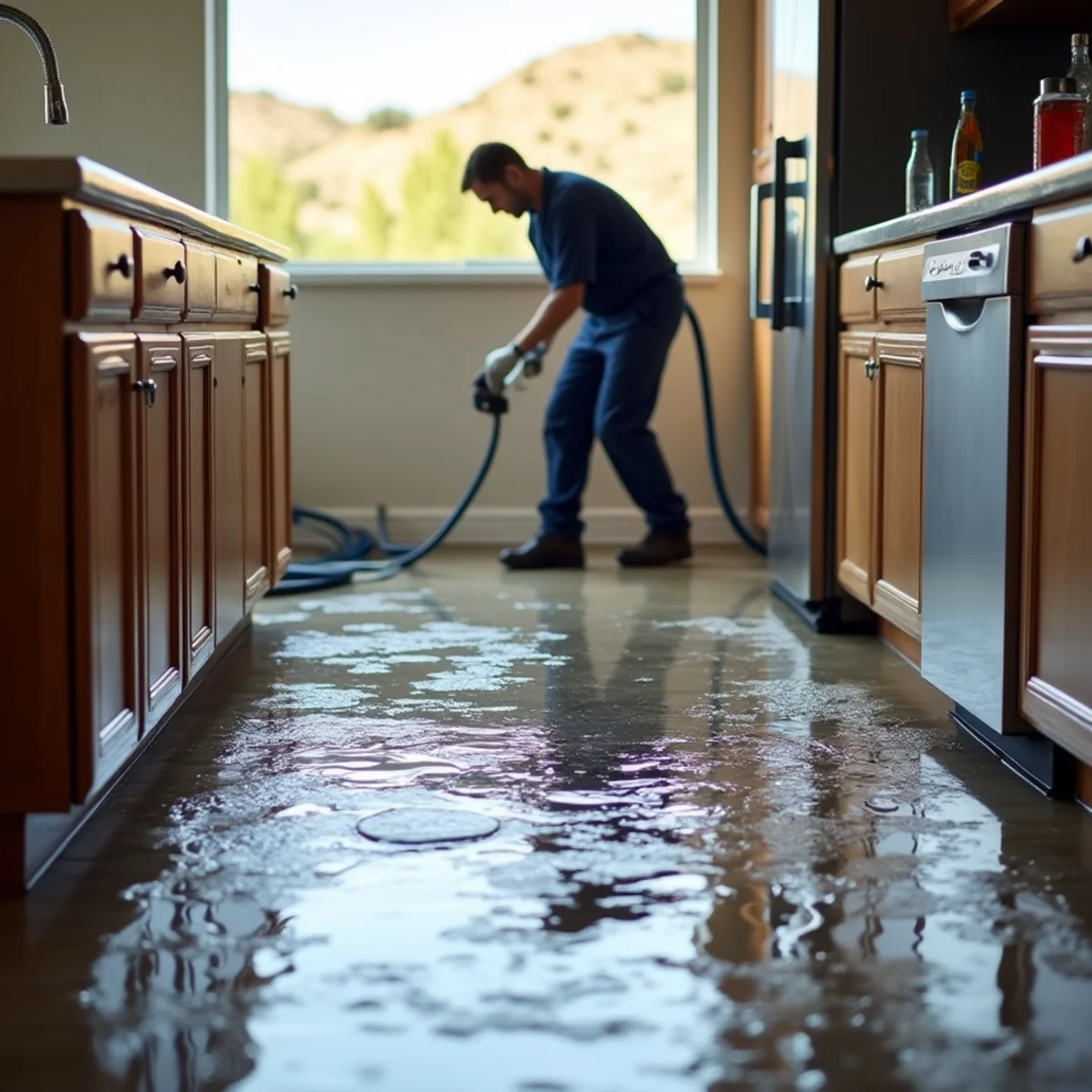
You came down to a wet kitchen floor. The obvious response is to mop it, run the fan and get on with your day — and that response is why we get called to these kitchens six weeks later for mold remediation.
The problem with a dishwasher leak is geometry. The appliance sits in a recess under the counter, surrounded by cabinet boxes and typically installed before the finish flooring went in. Water leaving it goes in three directions you cannot see: under the adjacent cabinet bases, beneath the flooring through the gap around the appliance, and into the toe-kick void that runs continuously under a whole cabinet run.
Water damage happening right now?
We answer live 24 hours a day and commit to a 60-minute response across San Ramon.
+1 (201) 277-9344First Steps
 1
1Stop the water
Close the dishwasher supply valve — usually under the adjacent sink, a small valve on the hot line feeding a flexible connector through the cabinet wall. If you cannot find it, close the main. Then switch off the dishwasher circuit at the panel, since it is a wet appliance.
 2
2Do not run the dishwasher again to "test" it
Genuinely common and genuinely counterproductive. If it leaked once it will leak again, and you will add another cycle of water to a floor assembly that is already wet.
 3
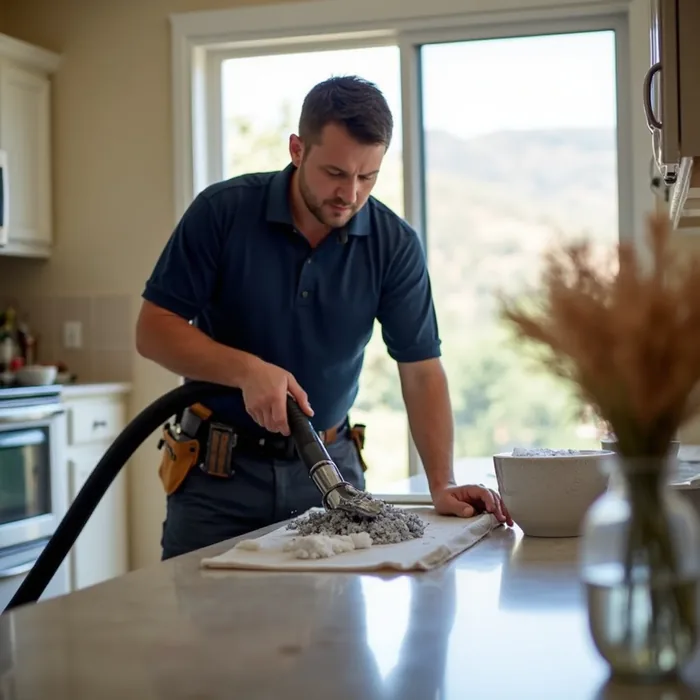
3Photograph everything before you mop
Video the water extent, photograph the cabinet bases, the flooring, and any visible source at the appliance. Once you have mopped, the evidence of how far it spread is gone.
 4
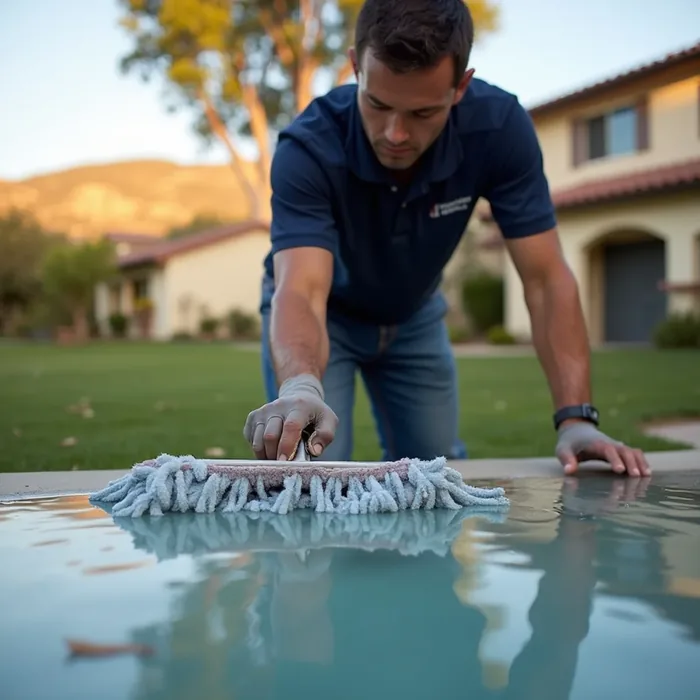
4Get the mopping done, then stop
Removing the surface water is worth doing. Just understand that it addresses maybe a tenth of the problem, and the rest needs equipment.
Where the Water Actually Went
This is the part that determines whether your kitchen needs a dry-out or a rebuild, and none of it is visible from the middle of the room.
- Under the dishwasher itself, onto the subfloor in a recess with no airflow — the slowest-drying spot in the kitchen.
- Into the toe-kick void, which usually runs continuously under an entire cabinet run and carries water several feet in either direction.
- Into cabinet bases and bottom shelves. If those are particleboard or MDF — which most are, even in expensive kitchens — they swell, delaminate and do not recover.
- Beneath laminate, engineered wood or vinyl flooring, through the expansion gap around the appliance recess. Water gets under the floating floor and is then trapped there.
- Into the base of the drywall behind and beside the cabinets, wicking upward.
- Through the floor assembly entirely if the kitchen is upstairs, showing up as a ceiling stain below.
Why "It Looks Dry Now" Is Not the Same as Dry
Surfaces dry first because they have air moving over them. Everything behind, beneath and inside dries last, or not at all. In a kitchen the wet areas are almost all in the second category — under an appliance, inside a toe-kick, beneath a floating floor, in a closed cabinet base.
Those spaces hold moisture at high relative humidity for weeks with essentially no air exchange. That is precisely the condition microbial growth needs, and it can begin within 24 to 48 hours. The first symptom is usually a musty smell near the floor that nobody can place; by the time it is obvious, the cabinet bases have been wet for a month.
The professional approach is to detect where the moisture actually is with meters and thermal imaging, then dry those specific voids — often by pulling the appliance, removing toe-kick panels to open the void, and directing airflow into it under contained conditions rather than pointing a fan at the room.
What Can Usually Be Saved
Speed and water category drive this, as always. A dishwasher leak is Category 2 — the water contains detergent, food soil and whatever came off the dishes, which means it carries meaningful contamination even though it looks clean.
- Cabinet boxes: usually salvageable if solid plywood and dried quickly. Particleboard and MDF boxes that have swollen do not recover.
- Toe-kick panels: cheap and easily replaced. We often remove them deliberately to access and dry the void.
- Tile and sealed stone flooring: generally fine, though the subfloor beneath may still need drying.
- Laminate and engineered wood: often not salvageable once water is under it, because the swelling at the seams is irreversible.
- Vinyl plank: sometimes salvageable, but the subfloor under it has to be dried, which usually means lifting sections regardless.
- Drywall at the base of walls: frequently dried in place if caught early, otherwise cut back to a clean line.
Stopping the Next One
- Check the supply connector at the dishwasher — the braided line under the sink — for corrosion or bulging once a year.
- Look at the door gasket. A perished or displaced gasket is the most common source of slow leaks that soak the floor in front of the machine.
- Pull the toe-kick panel off once a year and look underneath with a flashlight. Slow leaks show up as staining long before they show up as a flood.
- Put a leak sensor in the cabinet next to the dishwasher — they cost very little and they catch the overnight failures.
- Replace the appliance rather than repeatedly repairing it once it is past about ten years; the cleanup after a failure costs far more than the machine.
Why Kitchens Hide Water Better Than Any Other Room
A kitchen is the worst room in the house for finding water, because almost all of it is concealed. Cabinets sit on a toe-kick platform, appliances sit in enclosed bays, and the floor covering usually runs up to the cabinet line rather than under it. Water goes into all of those spaces and stays there.
That is why the visible puddle is a poor guide to the size of the job. What matters is what got under the cabinet run and into the subfloor, and neither is visible without pulling a kick plate or taking readings.
- The toe-kick cavity under a cabinet run holds water indefinitely with almost no airflow, and it connects the whole run rather than staying under one unit.
- Cabinet bases are usually particleboard, which swells irreversibly once wet and does not recover no matter how thoroughly it is dried.
- Water travels under vinyl, laminate and floating floors and sits on the subfloor, where nothing evaporates because the covering acts as a vapour barrier.
- Dishwashers sit in an enclosed bay, so a leak there wets the subfloor under the machine and the adjoining cabinet before it ever reaches open floor.
- The wall behind the machine takes water at the base, and the bottom plate stays wet long after the surface looks dry.
- If the kitchen is above a finished room, water follows the floor structure and shows up on the ceiling below, frequently at a light fitting some distance away.
Frequently asked questions
Not necessarily. Solid plywood cabinet boxes dried quickly usually survive. Particleboard and MDF bases that have swollen and delaminated do not recover and need replacing. Toe-kick panels are inexpensive and are often removed deliberately to dry the void behind them.
It is Category 2 — grey water. It contains detergent, food soil and biological material from the dishes, so it carries meaningful contamination despite looking clean. Carpet pad and other porous materials it reaches are normally replaced rather than dried.
Probably. Surfaces dry first because air moves over them; the water under the dishwasher, inside the toe-kick void, beneath floating flooring and in the cabinet bases has no airflow at all. Those spaces stay wet for weeks and are where growth starts. A moisture meter answers the question definitively in a few minutes.
It depends on the material. Solid wood boxes and plywood carcasses can often be dried in place by removing the kick plates and directing air into the toe-kick cavity. Particleboard bases that have swollen are finished — the swelling is irreversible and the material has lost its structure. We assess unit by unit rather than condemning or saving the whole run.
The supply line is, but the water in the machine during a cycle is not. Once it contains detergent, food waste and whatever came off the dishes, it is Category 2 — not a health emergency, but not something to leave sitting in a cabinet cavity either. Category 2 water that sits long enough degrades to Category 3, which is another reason overnight leaks scope differently from ones caught immediately.
The short version
Close the valve, kill the circuit, photograph it, mop the surface — then get someone to check what is under the cabinets and the floor before you assume it is over.
We handle kitchen water losses across San Ramon with moisture mapping, targeted cavity drying and honest answers about what will and will not come back.