When to Replace Washing Machine Hoses, Water Heaters, and Supply Lines (The Ages That Matter)
Every component has a service life. Replacing on age costs a little; replacing on failure costs a floor.
Written by the San Ramon Water Damage Pros crew — IICRC-certified technicians working to the ANSI/IICRC S500 standard on water losses across San Ramon and the Tri-Valley. Guidance here reflects how we actually run jobs, not general advice.
Nearly every water loss we attend involves a component that had reached the end of its service life. Not a defect, not misuse — just age. The parts that connect your plumbing to your fixtures and appliances all wear out on a reasonably predictable schedule, and on Tri-Valley water that schedule is shorter than the national figures.
Here is what to replace and when, roughly ordered by how much damage the failure causes.
Water damage happening right now?
We answer live 24 hours a day and commit to a 60-minute response across San Ramon.
+1 (201) 277-9344Washing Machine Hoses — Every 5 Years, or Once to Stainless
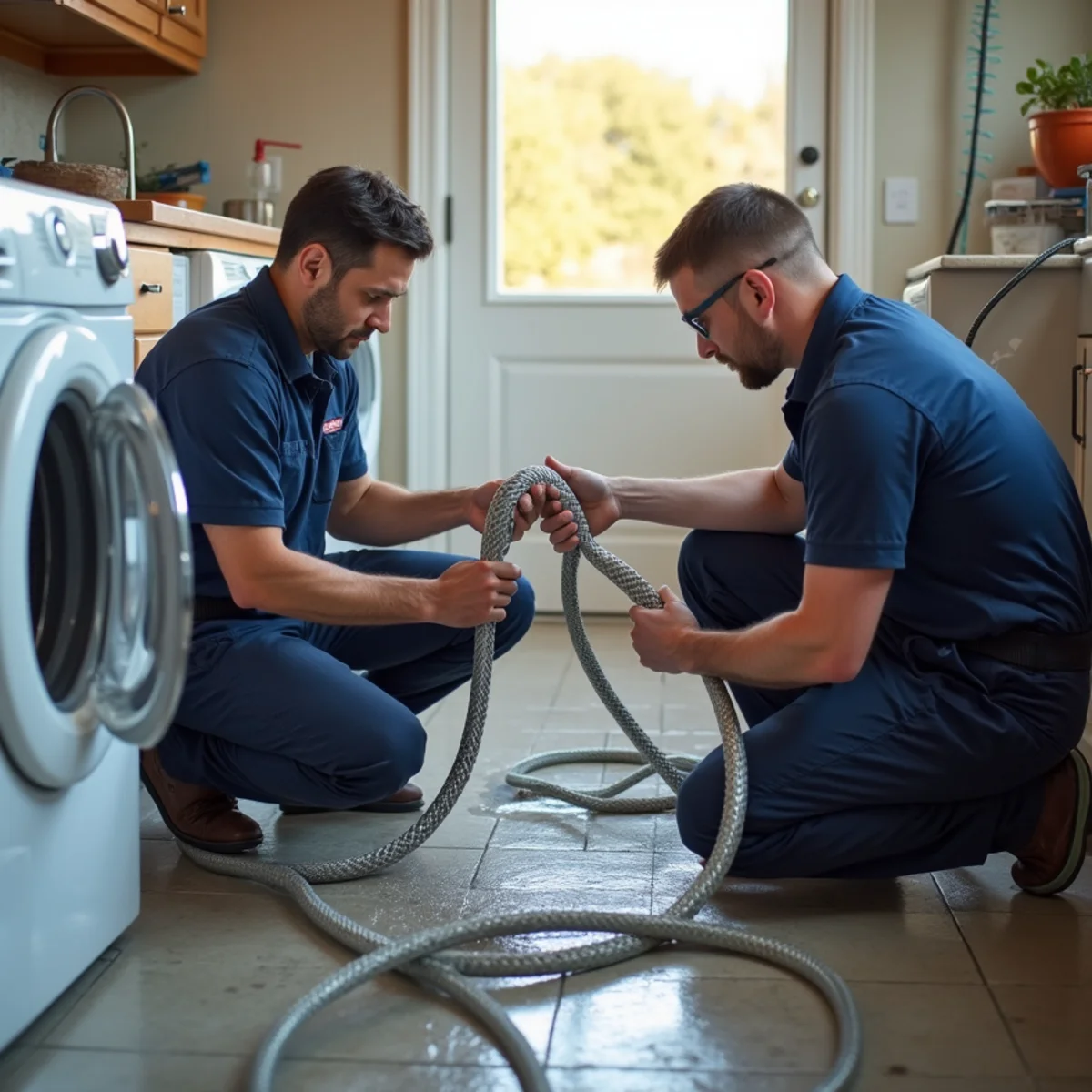
The highest-consequence cheap component in the house. A washer hose sits under full line pressure 24 hours a day whether the machine is running or not, and when one lets go it delivers water at full flow until someone closes a valve — usually while nobody is home.
- Rubber hoses: replace every 5 years, without exception.
- Better: replace once with braided stainless steel. About thirty dollars, twenty minutes, and they fail far less often.
- Check twice a year for bulging, cracking, stiffness or corrosion at the fittings.
- Leave a few inches of slack so the hose is not under tension at the connection.
- Close the supply valves if you are away more than a few days — and exercise those valves so they still turn.
- Critical if the laundry is upstairs, where a failure drains into the ceiling below.
Water Heaters — 8 to 12 Years Here
Shorter than the national guidance, and the reason is the water. EBMUD supply at 16 to 18 grains per gallon deposits heavy scale on the tank floor, which insulates the burner from the water, raises the temperature of the tank floor itself, and accelerates the corrosion that eventually breaches it.
- Plan on 8 to 12 years. Past 10, replace on schedule rather than waiting for failure.
- Find the age from the manufacturing date encoded in the serial number on the label.
- Warning signs: rumbling or popping (scale), rust-coloured hot water, moisture at the base, reduced hot water capacity.
- Flush annually to slow scale accumulation.
- When replacing: two seismic straps into structure per HSC §19211, flexible connectors, and a drip pan plumbed to an actual drain.
- If the tank is on an upper floor or in an interior closet, add a leak sensor and consider an automatic shutoff valve.
Angle Stops and Supply Connectors — 10 to 15 Years
These are the small valves under every sink and behind every toilet, and the flexible lines running from them to the fixture. They are the most numerous water connections in the house and the most commonly overlooked.
Plastic-bodied angle stops used widely in 1990s and 2000s construction become brittle with age and can crack at the valve body — sometimes at the moment someone tries to close one, which is a particularly frustrating way to flood a bathroom. If you have them, replacing them with quarter-turn brass stops is inexpensive and worth scheduling rather than waiting for.
Braided connectors fail at the crimp or at the washer, typically after 15 to 20 years. Replace them whenever you replace a fixture, and inspect them during the monthly walkthrough.
The Rest of the Schedule
- Toilet fill valve and flapper: 4 to 5 years. Cheap, and a leaking flapper wastes water silently and continuously.
- Toilet wax ring: on removal, or if the toilet rocks or the floor around it is discoloured.
- Refrigerator ice-maker line: 5 to 10 years, and upgrade plastic tubing to braided.
- Dishwasher supply connector: with the appliance, or at 10 years.
- Sump pump: 7 to 10 years, with a battery backup fitted regardless of age.
- Water pressure regulator: 10 to 15 years. Test your pressure with a hose-bib gauge; above about 80 psi stresses everything downstream.
- Whole-house supply piping: copper in this water typically starts producing pinholes at 30 to 40 years. A second failure is the signal to plan a repipe.
How to Actually Keep Track
- Write the installation date on any component you replace, with a permanent marker, directly on it.
- Keep a simple note on your phone or in a kitchen drawer listing what was replaced and when.
- Photograph the water heater label so you have the serial number without going back to look.
- Set a recurring annual calendar reminder for the deeper checks.
- When you buy a house, assume everything is original unless you have documentation otherwise — and budget accordingly.
Doing It in the Right Order When You Cannot Do It All
A full replacement schedule is a reasonable amount of money at once, and most households would rather stage it. This is the order we would do it in, ranked by how much damage the failure causes relative to what the fix costs.
- Washing machine hoses, first and immediately — The highest damage-to-cost ratio in the entire house. Under permanent mains pressure, prone to sudden failure, and replaceable with braided stainless for very little. If the laundry is upstairs, this is not a scheduling question.
- The main shutoff valve, if it is an old gate valve — It does not prevent a leak, it limits every leak you will ever have. A valve that will not close converts a contained failure into a whole-house one, and that multiplier applies to everything else on this list.
- Water heater, once past its expected life — Large volume, and in an upstairs or interior-closet position it lands directly on finished space. Replace it on age rather than waiting for symptoms, because the failure mode is often a seam letting go rather than a warning drip.
- Angle stops on upper floors before ground floors — The same component fails the same way on both, but an upstairs failure damages two floors. Where budget is staged, upstairs first.
- Toilet and sink supply connectors — Cheap, quick, and they fail at the crimped fitting like everything else braided. Doing a whole house of them is an afternoon.
- Dishwasher and refrigerator lines — Lower pressure and lower volume than the above, but they leak into enclosed cabinet spaces where nothing is discovered for weeks. Worth doing whenever the appliance is next pulled out.
Frequently asked questions
Because the water is very hard — 16 to 18 grains per gallon. That mineral content precipitates as scale on the tank floor, insulating the burner from the water, raising the tank floor temperature and accelerating the corrosion that eventually breaches the tank. Eight to twelve years is realistic here rather than the longer figures quoted nationally.
Meaningfully. Rubber hoses degrade from the inside, soften, bulge and split, which is why the standard advice is to replace them every five years. Braided stainless costs a little more, lasts considerably longer and fails far less often. There is no good reason to run rubber washer hoses today.
For the cheap, high-consequence items — washer hoses, angle stops, a water heater past ten years — yes. The replacement cost is trivial next to a floor, a ceiling or a cabinet run, and these components fail on age rather than on any warning you will reliably notice.
Washing machine hoses and most toilet and sink supply connectors are within reach of a competent homeowner — close the valve, release the pressure, swap the hose, open the valve and check for weeping. Where it becomes a plumber's job is if the angle stop itself will not close or starts weeping when you turn it, which happens often enough on older valves that it is worth knowing where the main shutoff is before you start.
For the items on this list, yes — that is precisely the point. Braided hoses and angle stops give very little warning, and the ones that fail catastrophically usually looked fine the week before. Replacement on a schedule rather than on symptoms is the whole strategy, and it is cheap relative to any single loss it prevents.
The short version
Washer hoses at five years or once to stainless. Water heaters at eight to twelve. Angle stops and connectors at ten to fifteen. Write the date on everything you replace.
When one of them does let go, we answer 24 hours a day across San Ramon.